LES ANNALES DES MINES
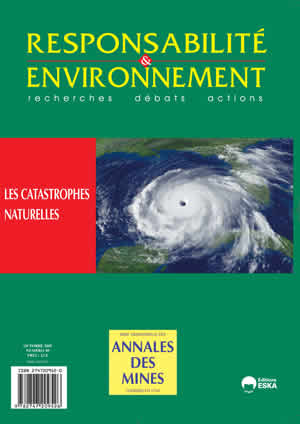
Responsabilité & Environnement n°40 October 2005
FOR OUR
ENGLISH-SPEAKING
READERS
|
Tectonics,
the current source of major earthquakes Paul
Tapponnier Cataclysms
have made millions of casualties during the past century. We now have
the
ability to predict major earthquakes and thus take measures in advance.
For the
most part, only major earthquakes are unforeseeable. Why? What we know,
what we
can do and how to advance toward making short-term predictions…
Claude
Jaupart Volcanos
still erupt, killing people. Major eruptions can affect the climate and
thus
have an impact on the population all over our planet. Vulcanology has
made
progress in both theory and observations during the past three decades.
What
point has the discipline reached? What can now be predicted? What hopes
for the
future?
Hélène
Hébert The
tsunami that struck Sumatra in December 2004 has aroused a new, global
awareness of such risks. This is going to stimulate prevention work. It
will
enable those who design models to experiment with methods and test them
against
the vast body of available data. At stake: improve the planning and
development
of coastlines; intervene so as to manage alerts; and better understand
the
physics of tidal surges, of their production, propagation and impact on
coastal
areas.
Anne
Mangeney Who
has not walked on, lived in or drove over what was left from a
landslide or
subsidence without even knowing it? The theoretical description and
understanding of the physics involved in these processes is still wide
open.
Tackling this question entails understanding a major factor in the
evolution of
a planet’s surface — the dynamic forces whereby matter shifts and
is
stocked. Beyond these theoretical aspects, a framework for managing
risks must
be adopted. |
Expertise
for preventing natural risks: The Séchilienne rockslide Michel
Bart Beyond
expected technical analyses and the advances made in our knowledge of
risks and
of the means for preventing natural disasters, a scientific task force
has
stimulated an awareness of dangers. It has thus moved actors to react
— thanks to exemplary work in terms of methods and results, and
thanks
also to a transparent, educational approach involving a dialog. Though
not
replacing action, this expertise does make
it possible to take actions: the case of the
Séchilienne rockslide
in Isère department, France.
Pierre-Yves
Bard et al The
French Riviera lies far removed from Japan or California, but the risk
of an
earthquake is quite high there. Nonetheless, prevention work still runs
up
against a low awareness of the dangers. For this reason, and as has
been
successfully done in countries facing higher risks, scenarios have been
designed to draw up prevention policies. Here are the major points
figuring in
the Gemgep Project, the most recent study conducted in Nice, France.
Yvette
Veyret and Magali Reghezza In
France, geography used to be part of the natural sciences before it
shifted its
grounds to the social sciences. Following in the footsteps of American
geographers who, in the early 20th century, started focusing on
the
“facts” of both nature and society, French geographers now, as they
study
contingencies and risks, insist on risk exposure and on the relations
between
risks, place and territory. Now discontinuous, “territories” are
becoming more
vulnerable as they are hooked up in networks.
Jean
Dunglas Volcanos,
cyclones, earthquakes, floods, landslides, tsunamis… our knowledge of
these
phenomena is growing fast. But for scientists and engineers, there is
still
plenty of room for progress in understanding risks and risk-exposure.
It is
senseless to imagine that we can avoid all natural catastrophes.
However,
better understanding the processes involved means improving our
knowledge of
how to protect ourselves. This challenge is all the more urgent given
the rapid
urbanization of our planet’s population. |
Do
natural catastrophes still exist? Jean-Pierre
Dupuy How
could Katrina, the hurricane of 29 August 2005, be compared with
the
terrorist attack of 11 September 2001? Because we thought people were
somehow
responsible for the devastation. Because Western science, underlaid by
religion, has gradually pushed the bounds of human actions outwards
— till
the ultimate, outermost limit of an alien, powerful. Coming droughts,
cyclones or
tsunamis will, therefore, be the unexpected outcome of our actions.
Scott
Shane and Eric Lipton in the International Herald Tribune,
3-4 September 2005 Katrina
should not have taken officials, whether federal or local, unawares.
The
hurricane had been expected for several years. Evidence of this are the
hundreds of thousands of dollars spent on the likes of studies, drills
and
emergency plans. Nonetheless, the conclusions drawn were uncertain; and
authorities have been unable to respond to the need to provide shelter
to
thousands of people, or to evacuate those who could not leave on their
own.
Let
Katrina be a warning… John
Carey, Lorraine Woellert, Eamon Javers and Otis Port on BusinessWeek
online,
1 September 2005 Katrina’s
devastating effects were perfectly foreseeable and… avoidable. Beyond
the
controversies about unheeded warnings or policy shortcomings, lessons
are to be
drawn with regard to how we manage energy and natural resources. |
|
|