LES ANNALES DES MINES
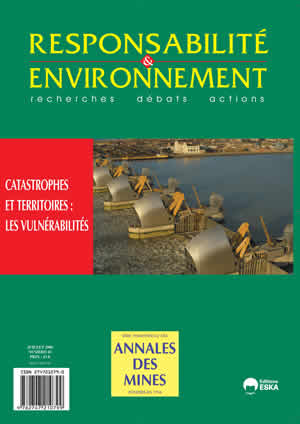
Responsabilité & Environnement n°43 July 2006
FOR OUR
ENGLISH-SPEAKING
READERS
|
Catastrophes
and localities: Vulnerability
Yvette
Veyret and Magali Reghezza For
a long time, studies have focused on risks and hazards more than on
vulnerability or risk-exposure. And for a long time, societies have
reacted by
giving priority to protective measures and technical solutions for
reducing
risks or limiting the effects. During the 20th century, the
analyses of
certain French geographers did, however, take the notion of
risk-exposure into
account. The approaches adopted along with the perspectives thus opened
are
reviewed as well as the contribution of this concept to
risk-management. The
practical limits of its application are examined as illustrated by its
integration in risk-prevention plans.
Erwann
Michel-Kerjan There
have always been catastrophes, but data collected over the past fifteen
years
clearly show that more and more large-scale destructive events are
occurring at
an ever increasing cost. This trend raises, once again, the issue of
the
exposure to these new risks and the question of risk-management, in
particular
financial coverage. Who should pay for the economic and social
consequences?
How to “share” risks? The role and responsibility of the private sphere
and,
too, of the government are called into question.
Carmelo
di Mauro and Sara Bouchon How
to make the concepts of risk and risk-exposure operational? How to
advance
knowledge by developing techniques for assisting decision-making?
Answers can
be gleaned from the experiences of the Piedmont and Varese Province,
and from
the implementation of innovative techniques for improving risk
management, in
particular, for better assessing the exposure of localities to risks.
Sara
Bouchon How
to foresee the impact of a major blackout? of a rupture in the supply
of
drinking water? of a paralysis of a system of transportation? Given
these new
threats to vital infrastructures, how to locate spatially the points of
vulnerability if a critical service breaks down? How to analyze and
measure the
effects? The problems encountered in this field reveal the difficulties
societies have in foreseeing and managing a new type of risk. Diagnosing
risk-exposure to flooding: An effective means of prevention Nicolas-Gérard
Camp'huis and
Claire Devaux-Ros Floods
in southeastern
Jean-Luc
Salagnac Down
through the centuries, construction changed from being an empirical to
a codified
procedure. Tools for preventing natural risks have been developed and
are now
permanent. But there is no lack of reason for modifying them: advances
in
knowledge, new experiences, the analysis of the structural framework of
older
buildings, the possible effects of a probable climatic change… The
requirement
of overall coherence and, therefore, the need for more cooperation
between
various parties must be borne in mind.
Bernadette
de Vanssay The
sociology of disasters was born out of WW II and the inability of
science
and technology to cope alone with emergencies. It developed following
various
catastrophes that marked the 20th century. Sociology, psychology,
political science, geography and history have, in turn, been put to
use.
Initially in the
|
Theresa
Wilson Big
floods inevitably cause human lives to be lost, but there are also
casualties,
even deaths, due to imprudent acts. Braving danger to rescue goods or
lives,
seeking shelter, or simply being curious and wanting to have a look…
the range
of risky behavior is broad. But how common is such behavior? And what
motivates
it? These two questions must be answered if the number of avoidable
deaths
during a catastrophe is to be reduced. Drawing
the lessons from Katrina Paul-Henri
Bourrelier Eight
months after hurricane Katrina devastated
Michel
Badré and Philippe Huet Although
natural risks are often managed in an emergency once they happen, the
announced
Séchilienne landslide is an exception. For more than twenty
years, this complex
risk in the French Alps has been analyzed, and authorities have made
decisions
based on the presumed dangers of an event that has not yet taken place.
This
description of an atypical process of risk-management discusses the
approaches,
results and questions related to this predicted risk.
Miscellany :
Reach
Catherine
Tissot-Colle and Catherine Lequime Manufacturers
did not wait for the project Reach before showing interest in the risks
of
their products for health and the environment. Though sharing the aims
of this EU
project, which has no equivalent elsewhere in the world, they are
concerned
about its impact on firms in a highly competitive, global environment.
The
debate during 2005 has cleared up some points and simplified others,
but major
concerns still exist.
Pablo
Libreros Reach
is intended to reform procedures for managing risks in the European
chemical
industry by 2007. This EU reform is a response both to a social demand
and to
advances in knowledge. Its objective will have a major cultural impact
on all
parties: manufacturers, the industries that use chemicals, public
authorities,
associations and consumers. Whether new regulations will be successful
depends
on the implementation of this reform in everyday life.
Jacky
Bonnemains From
exclusions to exemptions, from uncertain deadlines to unrealistic
objectives,
the supranational war machine against risky chemicals — the way
some
parties see Reach — might turn out to be a mere ersatz, a European
institute restricted to recording, without controlling, a few thousand
chemicals by 2010-2020. Obligations of accountability, surveys of
environmental
organizations, research by toxicologists and epidemiologists, the
chemical
industry’s efforts and the vigilance of EU member states… a steady
course must
be steered, with or without Reach.
An
interview with Corinne Lepage, president of Cap 21 and former minister “Reach
must be seen as a component of public health and, too, as an
intelligent vision
of the economy and industry. It is high time to change our way of
looking at
the economy; if we do not do so very soon, we are going to pay a high
price.” |
|
|