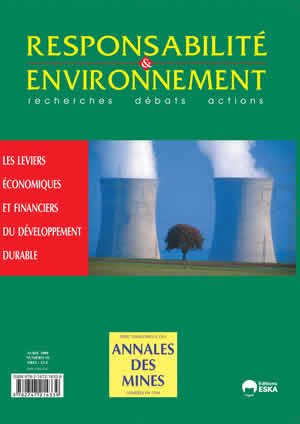
N° 50 - April 2008 - The economic and financial levers of sustainable development N° 50 - April 2008 - The economic and financial levers of sustainable development
Issue editor: Alain GRANDJEAN
associé de Carbone 4
To read summaries, click on the article titles
Editorial : François Valérian,
Rédacteur en chef des Annales des Mines
Introduction: The financial crisis and sustainable development
Alain Grandjean
associé de Carbone 4
Corporate finance and sustainable development
From preventing risks to anticipating opportunities in the marketplace: The new frontier of big business’s environmental policy
Elisabeth Laville
fondatrice du cabinet Utopies
Sustainable development: The necessity of changing behavior or an opportunity for clean technology?
César de Brito
Gérant de portefeuilles chez Lombard Odier Darier Hentsch & Cie
Financing the environment
Arnaud Berger
Environmental bookkeeping
Jean-Paul Séguret
Président du cabinet Constantin
Socially responsible investments at the crossroads: A manifesto for a responsible performance
Jean-Philippe Desmartin, Valéry Lucas-Leclin et Stéphane Voisin
The need for governance
A European climate policy and adjustments at the border
Olivier Godard
Directeur de recherche au CNRS et professeur chargé de cours à l'Ecole polytechnique
The evolving CO2 market in Europe and electric issues
Jean-Paul Bouttes,
Directeur de la stratégie, de la prospective et des relations internationales, EDF
François Dassa,
Anime le pôle relations internationales de la Direction prospective et relations internationales, EDF
et
Jean-Michel Trochet
Economiste senior, EDF
Specifications and major international standards in relation to sustainable development
François Fatoux
Délégué général de l'ORSE
The protection of intellectual property rights and sustainable development
Claude Henry
Ecole polytechnique et Sciences-PO
Good corporate citizens, a vision of the future
Marcel Grignard
Secrétaire national de la CFDT, en charge du développement durable et de la RSE
“Scarcity looking for governance”… Desperately?
Dominique Dron
Ecole des Mines de Paris, Centre énergétique et procédés
et
Hervé Juvin
Président d'Eurogroup Institute
Miscellany
Methodological and practical aspects of the assessment of chemical risks in big firms
Caroline Dechaume-Moncharmont, William Dab et Martine Courtois
Cnam, Chaire Hygiène et Sécurité
For a scientific debate on climate change
Vincent Courtillot
Membre de l'Académie des sciences
|