LES ANNALES DES MINES

REALITES INDUSTRIELLES

FOR OUR ENGLISH-SPEAKING READERS  -  November  2008


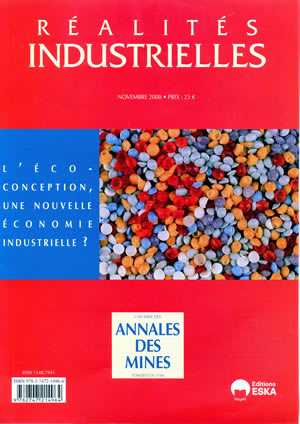
Ecodesign, a new industrial economy?

Issue editor: Marie-Josèphe Carrieu-Costa

Editorial
Pierre Couveinhes

 
Foreword: Ecodesign, an environmental economics — toward a new industrial socio-economy
Marie-Josèphe Carrieu-Costa

Ecodesign is a special tool for turning sustainable development, based on a new equilibrium, into reality. It opens the way toward a new industrial economy — a “socio-economy”.


Tools, processes and methods in question

 
Ecodesign, a few questions for architecture
Pascal Gontier

Thanks to the development of an architecture based on the idea of a “passive building”, the efficiency of heating has improved tremendously. Other environmental issues just as important, such as natural lighting or the management of water and garbage, have often been left in the background. In fact, part of the gains from improved heating has been offset by the growing consumption of energy for ventilation, air-conditioning and lighting. A new generation of environmental friendly buildings will have to take account of all forms of energy consumption — not just the energy used to occupy them but also the “shady” category of the energy for making and using construction materials.

 
Ecotechnology in the building trades
Bruno Peuportier

Tools have been developed to assess the environmental impact of buildings by taking into account the making of construction materials, operations at the building site, the use of the building (heating and water consumption), its demolition, and the processing and recycling of its rubble. These tools for assisting decision-making can serve to study technical innovations with regard to environmental quality.

 
Toward buildings with a positive energy balance
Jean-Christophe Visier

As the results of the recent “Grenelle of the Environment”, which assembled French officials and organizations for a wide-ranging discussion of ecological issues, enter into application, buildings should gradually switch from being the foremost consumers of energy to becoming producers of energy. The stakes, technically, economically and socially, are enormous.


Packaging and the environment: An assessment and the prospects
Charles Tissandié and Yannick Knapp

The environmental impact of packaging still sparks strong reactions in public opinion. Remarkable progress has been made in recent years thanks to simple, logical measures and changes in regulations. The future of packaging is ecodesign. It takes into account a product’s environmental effects throughout its logistic cycle and life. This calls for more sophisticated analytical tools, which are now being developed.

 
The analysis of a product’s life cycle and ecodesign: Keys for a new chemistry
Sylvain Caillol

The process of innovation in industry, particularly the chemical industry, is undergoing a change. It must be integrated into the ecodesign of products and procedures. From this viewpoint, the life-cycle analysis, a tool used to identify effects on the environment, falls short. A new tool, integrated in the process of innovation, is needed for steering ecodesign. Small business should be able to use it.


Energy and materials: New points of view

 
Wastes: Toward a circular economy
Diane d’Arras

Managing the wastes produced by our way of living and the growing population (especially in cities) is a challenge for our societies. It must be taken up with regard to the objectives set by the recent “Grenelle of the Environment”, in particular the operational measures foreseen for reducing and recycling wastes.


More electricity for less CO2
Yves Bamberger

Efficient solutions based on electricity exist for energy consumption by buildings, industry and transportation. Replacing the combustion of fossil fuels with them should significantly reduce CO2 emissions. On account of hydraulic and nuclear power, most of the electricity produced in France does not come from fossil fuels. This proportion should even increase in the future thanks to both the European pressurized reactor (EPR) and renewable energy sources, including wind power.

 
Ecodesign and renewable raw materials: Biodegradability — the example of polymers
Alain Copinet

Ecodesign often invokes the concept of biodegradability. What does this mean? Several sorts of natural polymers are produced from renewable resources; but how to measure their biodegradability? What are the impediments to developing these products? How to overcome them?

 
Geologically stocking CO2, a solution in the fight against climatic change
Jean-Michel Gires

Using fossil fuels still seems a necessity for the coming years. Given this, how to keep the CO2 thus emitted from spreading into the atmosphere? Capturing CO2 and stocking it in the earth hold promise.

 
From company to consumer: New requirements

Is ecodesign profitable for business?
Matthieu Glachant

In one opinion poll after another, consumers never stop declaring their concern about environmental issues. But do their purchases actually reflect this concern? Firms are proudly boasting about their “performance” on environmental questions. But are they actually designing and backing “green” products? What role should public authorities play in this context?

 
Managing sustainable development at Lafarge
Olivier Luneau

A world leader in building materials, Lafarge is the only firm in this industry that, in 2008, is listed among the 100 transnational corporations that are the most committed to sustainable development. For several years now, Lafarge has been trying to reconcile several concerns: industrial efficiency, the creation of value, respect for people and cultures, protection of the environment, the conservation of natural resources and saving energy.

 
An example of ecodesign in agribusiness: AgriMip Innovation, a pole of competitiveness in the Midi-Pyrénées region
Hubert de Rochambeau, Thierry Véronèse and Patrice Roché

Agricultural products must satisfy both consumer needs (tastes and consumer confidence in produce and production processes) and citizen demands (a responsible, environmental friendly industry and agriculture). AgriMip Innovation’s ambition is to design an engineering of innovation adapted to this situation thanks to an original analytical tool: “agro-chains”.

 
Small businesses faced with ecodesign and sustainable development
Sophie Boutillier, Olivier Contant and Claude Fournier

The concept of ecodesign was born in big corporations. Can it be transposed to small businesses? The development of environmental analysis software (product life cycle, energy balance, ecological footprints) has opened an access to environmental data for small firms. But might the latter not already be involved in ecodesign without knowing it? A study conducted in the Nord-Pas-de-Calais region suggests this.

 
Ecodesign, an added value for firms and a future factor in competitiveness?
Myriam Puaut

As feedback from experience shows, a step in finding the way to reduce a product’s impact on the environment is to become aware of it. This new way of looking at products opens possibilities for technical improvements and innovations. It is an additional driving force in creativity. It can increase a product’s environmental added value, make it stand out from rivals and even respond to new expectations in the marketplace.


retour sommaire