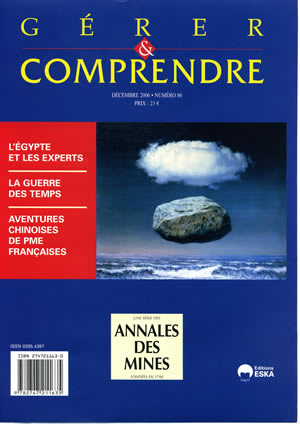
N° 86 - Décember 2006 N° 86 - Décember 2006
To read summaries, click on the article titles
Editorial: Francis LEFEBVRE
TRIAL BY FACT
Time warfare
Jean-Emmanuel RAY
Professeur à l'Université Paris 1 (Panthéon-Sorbonne)
WHILE READING
Egypt and the experts
Michel Callon
Professeur à l'ENSMP
OVERLOOKED…
a href="../../2006/resumes/decembre/03-gc-resum-FR-AN-AL-ES-decembre-2006.html#03AN" class="texte12ptgras">The paradox of “being behind” in the aerospace industry
Victor DOS SANTOS PAULINO
Université de Nice, Sophia Antipolis, DEMOD/GREDEG
TRIAL BY FACT
a href="../../2006/resumes/decembre/04-gc-resum-FR-AN-AL-ES-decembre-2006.html#04AN" class="texte12ptgras">Veolia Environnement: A model of hybrid organizational change
Christophe PLOUVIER
Ecole Polytechnique
MOSAICS
Michel Villette:
On the difficulty of referring to practices: On Michel Berry’s Managements de l'extrême (Paris: Éditions Autrement, 2006).
Jean-Michel Saussois:
Foucault and management: How are they related? On Armand Hatchuel, Éric Pezet, Ken Stackley and Olivier Lenay’s Gouvernement, organisation et gestion: L'héritage de Michel Foucault (Quebec: Presses de l'Université de Laval, 2005).
Alain Henry:
Mythology of the “Moderns”: On Philippe d'Iribarne’s L'étrangeté française (Paris: Seuil, 2006).
Marie-Anne Dujarier:
Psychology at labor’s bedside: On Dominique Lhuilier’s Cliniques du travail (Paris: Éditions Érès, 2006).
OTHER TIMES, OTHER PLACES
a href="../../2006/resumes/decembre/05-gc-resum-FR-AN-AL-ES-decembre-2006.html#05AN" class="texte12ptgras">The "joint adventures” of French small and medium-sized businesses in China: A case study, 1994-2004
Michèle DUPRE
Sociologue, chercheur associé au GLYSI-SAFA, ISH-LYON
and
Etienne de BANVILLE
Chercheur économiste CNRS au CRESAL, à Saint-Etienne
a href="../../2006/resumes/decembre/06-gc-resum-FR-AN-AL-ES-decembre-2006.html#06AN" class="texte12ptgras">Reforming public research in Japan: An overhaul
Hiroatsu NOHARA
Chargé de recherche au LEST-CNRS
|