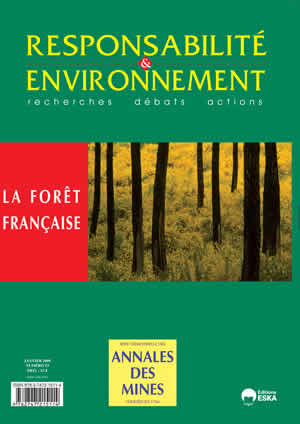
N° 53 - January 2009 - French forests N° 53 - January 2009 - French forests
issue editor : Renaud Abord de Châtillon,
Ingénieur général des Mines, membre du Conseil Général des mines
Ancien Vice-président de la Commission Française du Développement Durable
Président de Forestiers Privés de Bourgogne
Président de l'Association Bourguignonne de Certification Forestière
To read summaries, click on the article titles
Editorial: Pierre Couveinhes,
Rédacteur en chef des Annales des Mines
Foreword : A new challenge for French forests
Michel Barnier
Ministre de l’agriculture et de la pêche
Introduction : French forests, an inventory
Renaud Abord de Châtillon
Ingénieur général des Mines, membre du Conseil Général des mines
Ancien Vice-président de la Commission Française du Développement Durable
Président de Forestiers Privés de Bourgogne
Président de l'Association Bourguignonne de Certification Forestière
The legal and regulatory framework: Tapping available resources
The history of a forest torn between Colbertism and liberalism
Jean-Louis Guérin
Directeur adjoint du Centre Régional de la Propriété Forestière (CRPF) de Bourgogne
Private forests, a misappraised potential
Michel de Galbert
ENGREF 1977, Directeur du Centre Régional de la Propriété Forestière Rhône-Alpes
Communal woodlands at the service of sustainable forestry and local development
Jean-Claude Monin
Président de la Fédération Nationale des Communes Forestières (FNCOFOR)
Do property rights still exist in woodlands?
Vincent Ott
Président du Syndicat des Forestiers Privés d'Alsace
Using the resources of French forests
Jean-Marie Ballu
Ingénieur général du Génie Rural des Eaux et des Forêts
Président de la Section "nature, forêt, paysage" du Conseil général de l'agriculture, de l'alimentation et des espaces ruraux (CGAAER)
Forests in the world
French forests and Europe’s forestry policy
Ségolène Halley des Fontaines
(IGREF), Sous-directrice de la Forêt et du Bois,
ministère de l'Agriculture et de la Pêche
The forest and wood industry in Europe and the world
Daniel Guinard
Directeur général du FCBA (Institut technologique Forêt, Cellulose, Bois-construction, Ameublement)
Silviculture out to conquer the planet: “Imitate nature, hasten its workings”
Marie-Jeanne Lionnet
Versailles - Bibliothécaire retraitée de l'Ecole forestière de Nancy
Agro Paris-Tech
Forests: An asset in sustainable development
Certification, a major strategic tool for implementing a policy of sustainable forestry
Renaud Abord de Châtillon
Président de l'Association Bourguignonne de Certification Forestière (ABCF)
et
Matthieu Lesne
Chargé de mission de l'Association Bourguignonne de Certification Forestière (ABCF), délégué régional PEFC
The Morvan Forest Charter
Anne-Catherine Loisier
Maire de Saulieu, vice-présidente du Parc du Morvan et co-présidente de la commission forêt
French forests, a rich but menaced biodiversity
Daniel Vallauri
Fondation WWF-France
et
Emmanuelle Neyroumande
Responsable "Forêts, Fondaction WWF-France
The damage done to forests by the increasing number of storms or droughts
Philippe Riou-Nivert
Institut pour le développement forestier
(Centre national professionnel de la propriété forestière)
To produce more and better preserve resources: Forestry firms
Jacques Ducerf
Président d'APROVALBOIS
Conseil régional de Bourgogne
From wood to energy
Jean François Bontoux
Président de l'Association Française des Eaux et Forêts
Président de FRANCILBOIS
A look at the sustainable management of forests in France
Bernard Roman Amat
Ingénieur Général du GREF
Président de PEFC Lorraine
Directeur délégué du centre de Nancy d'AgroParistech-ENGREF
An experience as “forest delegate”
Henri Prévot
Ingénieur général des mines
|