LES ANNALES DES MINES

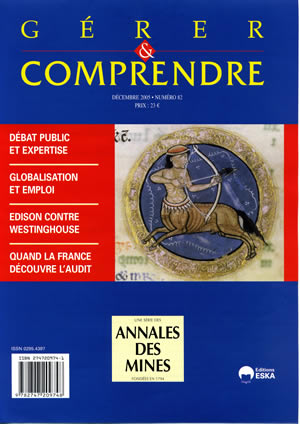
Gérer & Comprendre n°82

FOR OUR ENGLISH-SPEAKING READERS  


TRIAL BY FACT

Public debate and expertise: Between rationality and legitimacy

Sébastien Damart and Bernard Roy

The contexts of making decisions about transportation infrastructures have changed so much that public decision-makers are constantly subject to two sorts of requirements: rationalize the use of public resources and make choices that are acceptable from the viewpoint of the involved parties. The relations between requirements related to rationality (which the involved parties would like to see connected to decision-making processes) and those related to actual legitimacy (as in any collective process) are brought under question. The attempt to satisfy these two requirements is an effort to more closely articulate evaluation and debate — a pair that has been improved thanks, in particular, to preliminary public hearings and the role played by the National Commission of Public Debate (CNDP). Further improvements involve the means for socio-economic evaluations and practices related to economic appraisals.


Globalization and employment: The new organizational strategies of transnational agribusinesses in Europe

Amélie Seignour and Florence Palpacuer

The double strategy of globalization and of the creation of value in the stock market leads transnational agribusinesses to adopt convergent forms for managing employment and organizing work. The globalization of major operations in firms, the rising power of management control, the centralization and depersonalization of a dual human resource management, the breakdown of the Fordian social compromise… open new approaches to managing labor in big agribusinesses in Europe.


OVERLOOKED…

Illusory synergy in mergers and buyouts, an autopsy of the BioMérieux-Pierre Fabre “theranosis”

Philippe Monin and Eero Vaara

Mergers and buyouts are often justified by a hoped-for synergy in the effects. Specialists on this topic, whether academics or professionals, admit that initial ideas and justifications based on synergy often turn out to be unrealistic or even illusory. The processes at the origin of mergers or buyouts, as well as their evolution over time, are poorly understood. “Theranosis” was coined to refer to the merger of Pierre Fabre’s “therapeutic” skills with BioMérieux’s “diagnostic” know-how. Applied to this merger of two big pharmaceutical companies, announced in September 2000, and to their separation in June 2002, the theory of the “social construction of synergy” proposed herein identifies four phases considered to be characteristic of contemporary mergers and buyouts.


What institutional arrangements for the maintenance of aircraft materials in the defense system?

Denis Bayon and Thierry Kirat

The maintenance of aeronautic materials is a key question for the military since the operational availability of aircraft depends on it. It lies at the center of a complex system of organization and decision-making that no longer complies with the standard model of internalizing all responsibilities in the state. The following are increasingly taken into account: the costs of owning and rationalizing the defense system’s logistics; “benchmarking” in line with commercial practices in the civilian sector; and the equipping and maintaining of aircraft and their weapon systems. All this involves diversifying institutional arrangements, as seen through the cases of France, the United Kingdom and United States.


MOSAICS

Arnaud TONNELE: A debate with Francois Dupuy: On François Dupuy’s La fatigue des élites – Le capitalisme et ses cadres (Paris: Seul 2005).

Carlos RAMIREZ: The audited society? On Michael Power’s La société de l’audit: L’obsession du contrôle (Paris: Éditions de la Découverte, 2005) translated from English by Armelle Lebrun.

Frédérique PALLEZ: But what is the police doing? On Cpt. J. Terry and E. Bourguinat’s 1000 jours pour vaincre l'insécurité (Paris: Éditions Creaphis, 2005).

Michel VILLETTE: An emerging management theme, sustainable development: On Franck Aggeri, Eric Pezet, Christophe Abrassart and Aurélien Acquier’s Organiser le développement durable: Expériences des entreprises pionnières et formation de règles d’action collective (Paris: Vuibert 2005).

           The USB key: A question for Christian Morel.


OVERLOOKED…

Edison versus Westinghouse: The first modern battle over an industrial standard?

Pascal Corbel

A new energy that emerged in the late 19th century would deeply change economic activities and everyday life. Electricity was going to become a fundamental element in the “technical system” (in the sense of B. Gille) about to take the place of the iron-coal-steam one. This new energy soon became a major economic issue. Whoever managed to impose his conception of the networks to be set up for producing and distributing electric current would have a competitive edge. Two major names in American industry faced each other in what resembled the first modern battle over industrial standards; their weapons were not all that different from those being used nowadays.


TESTIFYING

 When France discovered auditing

Édouard Salustro interviewed by Bernard Colasse and Francis Pavé

In 1964, Edouard Salustro set up a chartered accountant’s office that would become one of the most important French ones. Deeply involved in the institutions related to his profession, he was president of the Ordre des Experts-Comptables from 1979 to 1982.This interview sheds light on the recent history of the bookkeeping profession in France. Following the post-WW II boom, auditing, a new profession, came into being in a new legal and economic context. New players also arose: the “big Anglo-Saxon” firms that still dominate this field. Only a few offices, such as Édouard Salustro’s and Robert Mazars’, were able to stand up to the competition.


Retour sommaire