LES ANNALES DES MINES
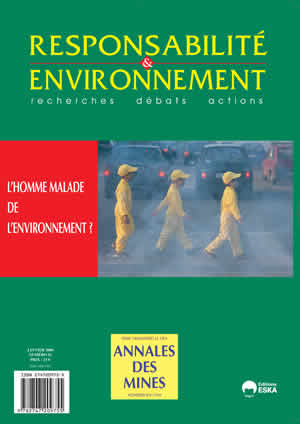
Responsabilité & Environnement n°41January 2006
FOR OUR
ENGLISH-SPEAKING
READERS
|
Sick from
the environment ? William Dab
Introduction : Denis Zmirou-Navier;
Conclusion :
Sylvaine Cordier The balance
sheet of the first phase of “Environment and health”, a program
launched in
1996 to stimulate the production of know-how on health risks related to
the
environment, contains proof of the potential for quality
research :
109 projects were selected, and research has been conducted for
five
years. Three of the principal specialists in the fields under study
— water,
cancer and reproduction — file reports. Research is continuing
under the
leadership of the AFSSE with the purpose of providing the government
with the
expert advice and scientific evidence needed to draw up public policies
on
health safety by setting priorities but while bearing in mind the long
run.
Philippe
Hartemann The
situation is still precarious, even in industrialized lands : one
and a
half billion persons worldwide still do not have water fit to drink. We
thus
see how important advances in knowledge are in this field : major
sources
of pollution, the principal diseases, and methodological developments
in
risk-assessment… 2. Reproduction
and the environment Sylvaine
Cordier Our
environment apparently has its share of responsibility in altering
human
reproduction, fertility and child development. There are hypotheses but
the
evidence is still too slack, despite monitoring systems and because of
the
difficulty of conducting epidemiological studies on this topic. 3. Cancer
and the environment Robert
Barouki and Philippe Beaune We are now
certain : cancer can have genetic or environmental origins. These
two
types of factors are not simple to weigh however. A too clear-cut
separation
between them turns out to be abusively reductionist. |
Denis
Zmirou-Navier The
incidence of cancer, the first cause of premature deaths, has increased
by 35%
over the past twenty years. To what extent are environmental factors
involved
in this trend? How to assess them? Beyond statistics however, the
environmental
factor carries much less weight than unhealthy or imprudent behavior
patterns,
even though progress in our knowledge has led to reworking these
estimates. What
also counts is the social acceptability of a risk by a population that
is,
rightly so, more demanding and better informed — whence the need for
public
authorities to pursue the effort to control these menaces by
intervening at the
source. This the stakes in the European programs EPR and Reach. Epidemiology
in environmental health : A methodological framework with several
applications closely related to the assessment of health risks Martine
Ledrans Air pollution,
waste incineration, the accident at AZF’s factory in Risks to
health, risks to ecosystems : Common points and differences? Eric
Vindimian Assessing
environmental risks necessitates forming a body of know-how and methods
common
to several disciplines. More than ever, research on the ecosystem and
on health
must be interrelated so as to fertilize each other. Biodiversity
against infectious diseases ? Denis
Couvet, Olivier Dehorter, Pierre-Yves Henry, Frédéric
Jiguet and Romain
Julliard More and
more attention is being given to infectious diseases and their control,
if only
for economic reasons. In this context, what can we learn from ecology,
in
particular from studying the interactions between human populations and
pathogens? One of the major challenges in managing ecosystems is to
maintain
sufficient diversity so as to contain disease vectors and hosts. In
this time
of globalization, this objective requires joint policies.
|
Henri
Prévot
Pascal
Bernard After two
significant failures in 2004, should we give up all hope of predicting
earthquakes? Seismologists have made advances in diagnosing a region’s
seismic
risks and predicting shifts in fault lines and their destructive
effects. This
progress associates theory with models and observations. Work still
needs to be
done to make these models operational for long- and mid-term
predictions. But
our major shortcoming has to do with observations. A colossal effort is
being
undertaken to develop the tools to make up for this.
Benjamin
Huteau and Jean-Yves Larraufie Our
conceptions of time have changed radically over the past decades. The
landscape
has teetered, our heritage has come under question. What we leave to
our
children has become a concern. Why has the idea, little by little,
gained
ground of an obligation toward future generations? To answer this
question,
three ethical theories, along with their practical implications, are
examined
that propose a basis for this new type of obligation. It is hard to
make these
theories compatible and impossible to put them into practice.
Nonetheless, they
might help us find bearings in the moral haze and discover
contradictions. |
|
|