LES ANNALES DES MINES
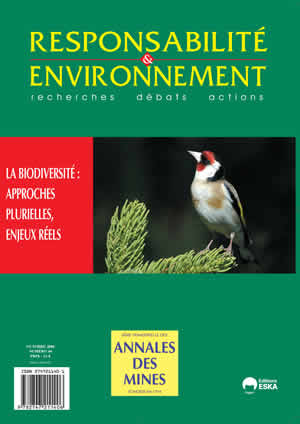
Responsabilité & Environnement n°44 October 2006
FOR OUR
ENGLISH-SPEAKING
READERS
|
Biodiversity: Multiple approaches, the
real issues A new look at the diversity of living
species Bernard Chevassus-au-Louis Given
its immensity, which will take centuries to inventory, given the deeply
unknown
complexity of interactions between its levels of organization, nature,
despite
its familiarity, still eludes our
understanding of its structure and workings. We have also discovered
how
fragile it is, and how much humanity is responsible for the diversity
of life
everywhere on the planet. This twofold observation leads us to supplant
a
linear view of the relations between knowledge and action with a
conception of
a “spiral of learning”, a process
whereby the questions “What do we want?” and “What do we know?”
mobilize all
parties interactively. Biodiversity, an issue in organizing
economically productive land Henri Décamps The
basic role of biodiversity as well as the need to protect it is no
longer seen
only as a matter of nature reserves, wildlife sanctuaries and parks.
Owing to
concerns based on production as well as conservation, these ideas have
gradually suffused the management of economically productive farm- and
woodlands. Meanwhile, the “ecology of landscapes”, a rather recent
branch of
environmental studies, presents us with a new view of the interactions
between
the spatial organization of ecosystems and the dynamics of
biodiversity. This
major change can lead to improving the management of biodiversity and,
thereby,
the resilience of farm and forest ecosystems. Despite contingencies of
all
sorts, managing the land used for economic purposes must, above all,
focus on
the notion of duration.
Jean-Luc Peyron Is
a rise in temperature, though still small, already affecting European
forests?
Is it a risk? The changing history of vegetation on earth can shed
light on
current trends and help us foresee those to come. We thus learn that
nature has
a not-to-be overlooked capacity for reacting to climatic phenomena. It
remains
to be known whether forests and the uses to which they are put can be
maintained. The still uncertain answer calls for innovations in
forestry.
Pierre Roussel How
to organize rural development and land management in the Marais
Poitevin area
of western
Jean-Pierre Raffin Both
science and society have debated the issues of hunting and biological
diversity. Since the 1970s, a longstanding quarrel has set hunters and
conservation societies at odds over the effects of the number of slain
animals
on game populations and the social impact of organized hunters, who are
seen as
being opposed to measures for protecting species and habitats. The
history and
analysis of a measure that, by maintaining the confusion between
hunters and
public authorities, creates two categories of citizens and obstructs
dialogue…
Frédéric Gosselin The
Northwestern spotted owl is a textbook case in conservation biology:
lawsuits
between environmentalists and industrialists, considerable funding for
research
and, in 1993, the release of the Northwest Forest Plan. But one of the
most
interesting points in this famous case has to do with the lessons to be
drawn
and questions to be raised about the interactions between science and
forestry.
How do research results affect forest management, its debates and
decisions?
How have relations these two fields been organized? Have their
different
cultural frameworks and time scales been able to operate together? How
to keep
the requirement of taking science into account from leading to
risk-averse
management or policies?
|
Managing biodiversity: What strategies for
a joint heritage? Henry Ollagnon The
causes for decreasing biodiversity are diffuse, complex et not
immediately
perceptible. Neither laisser-faire nor restrictions can be
major ways to
improve management. The solution is to look for a commonweal, a joint
heritage
based on a general interest, that will lead to a local and vertical
responsibility for biodiversity, whereby everyone becomes co-actors in
the
future of their territory and of the planet. It is within our scope to
take up
this challenge so as to maintain biodiversity by turning it into a
local,
common heritage with a general interest. This approach holds promises
for
coming generations; but we must, at present, place sustainable
development on
solid grounds. What is necessary is the confidence and willingness to
work
together.
Laure Tourjansky-Cabart and Bertrand
Galtier Science
is shedding ever more light on the advantages of biodiversity for both
our own
and coming generations. Nonetheless, the necessity of preserving
biodiversity
often seems to be a poorly understood regulatory and constitutional
restriction
instead of being seen as a way to prevent full-fledged damage, even to
the
economy. It is worthwhile re-emphasizing this issue so that more
attention be
paid to it in planning facilities and transportation… in the name of
the
principle of precaution, now enshrined in the French constitution.
Christian Barthod In Biodiversity : For what, for whom, by whom? Gilles Benest Biodiversity
is now in jeopardy. Although not the first time that biodiversity has
decreased
on the planet, it is the first time that human activities are held
accountable
and, too, the first time that humanity’s future is at stake. How to
preserve
our natural heritage? How to make private and collective interests
compatible?
Who can act? Conservation societies seem best suited to do this; they
have, for
a long time now, set the example and been able to win civic support. Biodiversity: Sustainable development and
geography Yvette Veyret and Laurent Simon Protecting
nature means, first of all, setting it outside the range of human
influence. By
emphasizing the problems of maintaining biodiversity, the advances made
in
ecology other the past few decades have brought the foregoing idea,
which is
still widespread, under question. Paradigms are shifting. Beyond any
purely
naturalistic analysis, the social sciences have opened new
perspectives, in
particular geography, which places biodiversity in a territorial
context and
thus takes into account the parties involved as well as social
practices and
issues. Talk about sustainable development is evidence of this trend,
even
though it sometimes serves as a cover for efforts to set nature aside
in a
reserve.
“Factor 4” Christian
de Boissieu, Richard
Lavergne and Jean-Claude Gazeau For |
|
|