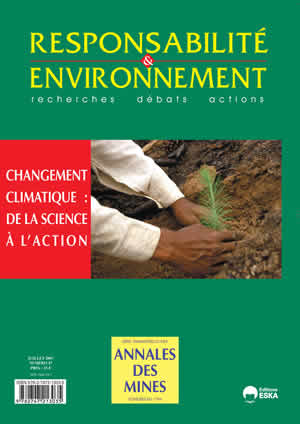
LES ANNALES DES MINES
Responsabilité
& Environnement n°47
Julyl
2007
FOR OUR
ENGLISH-SPEAKING
READERS
|
Global
climate change: François
Valérian
The
last report made by the Intergovernmental Panel on Climate Change has
concluded
that the average increase in global temperatures since the
mid-20th century mainly comes from rising anthropogenic emissions
of
greenhouse gases. This conclusion has come out of a slow process of
demonstration, which compared observations with simulations of climatic
change.
Most statistical studies that have detected signs of such a change and
attributed them to various sources, natural or human, have strengthened
the
experts in their conviction. Recent studies conducted in
For
twenty years now, scientific reports and studies have provided many a
figure
and map of possible future trends in our planet’s climate. Among the
results obtained
from various models, attention is turned toward the statistics and
trends
detected in French studies that are part of this international effort
to
simulate the climate for the planet as a whole, for a few regions, for Taking
stock: Fossil fuels Given
that fossil fuels now make up 80% of the energy supply for our planet’s
6,5 billion inhabitants, we must tap new reserves. The
21st century
is predicted to be a time of transition from heavy dependence on fossil
fuels
toward a diversification of energy sources and a growing share for
replenishable ones. Control will have to be exercised so that this
transition
will not harm our economies and will be acceptable to everyone.
Petroleum,
natural gas and coal will still form a major part of our energy supply
in the
coming decades. The problem in the middle run is not resources as such,
even
though they are limited, but rather their transformation into reserves
that can
be worked. Specialists are hesitating between two possibilities. The
consequences for farming From
rapeseed in Ecological
systems and climate change In
all environments, on land, in salt- or freshwater, ecological systems
are
changing in response to global warming. Though moderate till now, the
temperature increase over the past thirty years has already left its
marks on
life on our planet and set off far-reaching reactions. Simulations of
global
warming for the coming decades bear evidence of even bigger reactions,
ecological and, too, social as well as economic. It is urgent to slow
down current
trends. The
impact of climate change on the water cycle The
increasing concentration of greenhouse gases in the atmosphere makes
global
warming inevitable. Simulations of the climate provide us with a good
picture
of this phenomenon. Although projections for the water cycle are not so
clear
or certain, we should not conclude that this uncertainty justifies
putting off
preventive measures. It is highly probable that human populations and
societies
are much more (and much sooner) sensitive (and vulnerable) to
hydrological than
to thermal changes of the sort that will be occurring in a near future.
For
this reason, a major part of the planet’s population — the most
underprivileged — will bear the brunt first.
The need for
action
To
limit global warming, a larger proportion of our energy must come from
sources that
do not emit significant quantities of greenhouse gases. We can count
these
sources in short order. Besides replenishable sources, there is nuclear
energy.
Given the 442 nuclear power plants on the planet and the 2.600
billion kWh of electricity produced in 2005, this industry is
already
contributing significantly to the fight against global warming. It
could
enlarge its contribution were public reluctance overcome. Given the
scale of
our energy needs and the threat of global warming, nuclear power has
not-to-be-overlooked
advantages. It does not solve all problems, but the latter will not be
solved
without it. |
Replenishable
energy: How does it help fight against greenhouse gases and global
warming ? Since
renewable sources of energy do not emit greenhouse gases and are widely
spread
around the planet, they are — naturally — at the center of
all
prospective studies for reducing emissions. In particular, they lie at
the
center of the European Commission’s proposals for Saving
on energy in transportation The
fight against global warming is a major challenge for the
21st century.
The aim is no longer to save energy “along the margins” but to divide
by three
or four CO2 emissions by 2050. The Conseil
Général des Ponts et
Chaussées undertook, for two years, a futurological study to
determine how much
of these savings could come from transportation. There are solutions
for making
economic development compatible with social activities. Some of them
call for
decisions at the European or even planetary level; others involve the
responsibility of national governments and local authorities. These
solutions
are an obligation for all of us. How
to organize so as to halve CO2 emissions worldwide ? In
the coming fifty years, it will not be possible to cut worldwide CO2
emissions in half at a moderate cost unless all countries join in the
effort.
The best means would be a tax that would replace other fiscal
instruments in
national systems. It would simplify international negotiations by
limiting the
search for an agreement to two factors: the amount of the tax and its
rate of
increase. Furthermore, it would spare newly developing countries from
taking
paths that we have had to abandon. In transportation however, other
determinants affecting price schedules will have to be used. The
international climate in 2007 The
scientific evidence is accumulating: the damage due to climatic change
is
becoming ever more obvious. Tensions related to fossil fuels and
resources
characterize a world with more than six billion consumers. The status
of
negotiations about global warming has changed, this marginal
environmental
topic having become a key issue in North-South relations. We have fewer
than
ten years to start controlling emissions worldwide, and a scant three
years to
design and adopt, at the planetary level, a framework justifying this
control.
Will the gradual crystallization of interests in favor of a worldwide
response
to global warming enable us to catch up with climate change ? Controlling
emissions and the costs: The conditions for worldwide actions The
Kyoto Protocol, as amended or a new text… we must start preparing for
what will
happen after 2012. To
define the state’s role, the diagnosis must not be mistaken ! Henri
Prévot Heat
waves and hurricanes, ever more scientific reports, rising oil prices…
French
public opinion has changed to the point of accepting the idea of
reducing greenhouse
gas emissions. There is a risk: lest an error in the diagnosis conceal
the role
that the state should play. Although the price of petroleum has flared,
we
cannot be sure it will remain at a level high enough for humanity to
win the
fight against global warming. In its own interests,
Miscellany
Economic
growth, industrialization, an increase in purchasing power for part of
the
population and an acceleration of urbanization, all this has augmented
the
pressure and turned China into a major producer of greenhouse gases.
Will the
country straighten out, adjust its growth and make a “soft landing”? Or
will
the environmental menace disrupt development? Public authorities will
probably
impose more effective regulations and improve the efficiency of using
resources. The actual risk is indirect, and social: the path taken by |
|
|