|
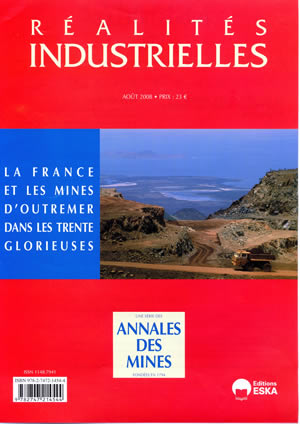
 August 2008 - France and overseas mining during the post-WW II boom August 2008 - France and overseas mining during the post-WW II boom
Issue editor: Paul-Henri Bourrelier
Ingénieur général des mines honoraire
To read summaries, click on the article titles
Editorial: François Valérian,
Rédacteur en chef des Annales des Mines
Foreword: Mining operations launched during the “thirty glorious” years of prosperity following WW II
Paul-Henri Bourrelier
Ingénieur général des mines honoraire
and
Jean Lespine
Coframines
Overseas mining operations: BRGM, a key actor in public policy
Paul-Henri Bourrelier
Ingénieur général des mines honoraire
Ancien Directeur général du BRGM (Bureau de Recherches Géologiques et Minières)
and Jean Lespine
Coframines
Appendix 1: La Société des Mines de Fer de Mauritanie (MIFERMA)
Marc Gallet
Appendix 2: COMILOG, a “success story”
Philippe Gros
Appendix 3: The Taiba phosphates (Senegal)
Louis Lasserre
Appendix 4 : The Togo phosphates
Jacques Houyvet
Société Le Nickel
Philippe Gros
Ancien président directeur général de la Société Le Nickel, 1986-1998
Société Minière et Métallurgique de Peñarroya
Gilbert Troly
Ancien Directeur de l'exploitation du groupe IMETAL
Uranium mines and French mining companies: A magnificent adventure
Jacques Blanc
Secrétaire Général de Cogema 1976-1987
Animateur et coordonnateur du Groupe Paucard
(histoire de l'uranium français) 1998-2007
France, an inspiration for attempts to stabilize world markets
Robert Diethrich
Chef adjoint de la délégation française au Conseil de l'étain de 1971 à 1976
président du Groupe d'étude du plomb et du zinc de 1976 à 1978
Miscellany
Gaston Moch, a cadet fighting for peace
par Paul-Henri Bourrelier
Ingénieur général des mines honoraire
Sharing scientific knowledge: Issues and risks (Report on the Rendez-vous du Club des Annales des Mines)
François Boisivon
Ecole de Paris du Management
Energy : Facts and figures from 2007
|