LES ANNALES DES MINES

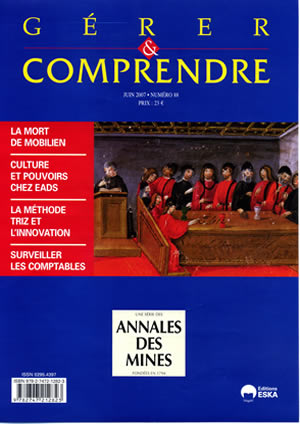
Gérer & Comprendre n°88 June 2007 

FOR OUR ENGLISH-SPEAKING READERS  


TRIAL BY FACT

Culture and power relations: A longitudinal analysis of the EADS Group

Christoph Barmayer and Ulrike Mayrhofer

Can the current balance of power in a group withstand an international merge? When created in 2000, EADS consummated an economic entente between France and Germany: a bicephalous leadership, equal shares, and a carefully upheld principle of symmetry. Everything had been designed to ensure that this model of equilibrium on the continent would last. Six years later, we are forced to admit that this conception of Europe has misfired. What centrifugal forces made the firm explode? The balance of power has yielded to the key values of each of the two peoples involved, and geographical dispersion has reinforced “national” molds of thought.

 
The death of Mobilien, or innovation at the risk of sacrificing cooperation

Antonio Gonzalez Alvarez

This lesson for whoever wants to introduce innovative ideas in public services presents a strategy by discussing the success and then failure of Mobilien, a plan for improving the bus network in the Île-de-France region: obtain support from a key committee by invoking a superior, general interest; profit from ambiguities in initial plans; and conform to the prevailing view of the world-to-be (“sustainable mobility”). Indeed; but the result has been a failure given the unwillingness to take into account opponents’ arguments in favor of private automobiles, the absence of involvement by key players (elected officials, engineers) and, above all, the lack of a strong project management capable of not backing down from certain basic objectives. Innovation and cooperation do not necessarily go hand in hand; nor do governance and project management. One must be capable of giving up on the idea of reaching a consensus while staying within the framework of representative  democracy!


OTHER TIMES, OTHER PLACES

Supervising accountants in France from the late 18th century to the period between the two World wars: The past of an illusory necessity

Pierre Labardin

What a change from the men trusted as bookkeepers in the 18th century to the very competent but supervised accountants of the 1920s! The 19th-century industrial revolution had taken place, but it would be a mistake to set this change down to purely economic reasons. As companies grew in size, other social relations took shape along with a new way of managing business. Bookkeeping would no longer be the responsibility of the owner alone; he would now have to control accountants, since he no longer trusted them.


OVERLOOKED…

Candide in the land of accountants: International Financial Reporting Standards (IFRS) as told to a young person

Daniel Gouadain

At the economy’s global level, what serves as the basis for relating a need for funds with a decision to invest? The same way of counting — and that is the crux of the problem. Do some people count better than others? Do some use criteria that are more valid than those used by others? Ultimately, might the winners be the largest group who counts in the same way? This dialog between an imagined Candide and an old hand raises for all of us the major questions now being tackled in accountancy: the ambiguous relations between Europe and the United States, the latter’s domination, and the margins of freedom still available.


MOSAICS

Michel Villette: Self-portrait of an “ideal-typical” businessman: On Noël Goutard’s L’outsider: Chroniques d’un patron hors norme (Village Mondial, 2005).

Arnaud Tonnele: Economics, between science and interests: On John K. Galbraith’s Les mensonges de l’économie – Vérité pour notre temps (Grasset, 2004).

Christine Blondel: The unconscious at the heart of family firms: On Jacques-Antoine Malarewicz’s Affaires de famille – Comment les entreprises familiales gèrent leur mutation et leur succession (Village Mondial, 2006).

 
TRIAL BY FACT

Reskilling: Optional prescriptions

Laurent Pascail

Qualifications are to be recognized for the good of wage-earners… this was the guiding idea in the reskilling programs launched fifteen years ago. However things were not so simple. The results of a survey of nine companies are used to review the purposes and expected results of this approach to job qualifications. New recommendations emerged, unexplored spheres of activity were taken into account, and the rationalization of firms improved. Yes, but the system only works if it provides, more than anything else, incentives. Directions must be optional, and be discussed; and they must lead to concrete improvements for wage-earners. Otherwise, the idea of shifting more responsibility onto wage-earners risks having no positive effects for employees, who realize that their autonomy is shrinking. A firm purchases, we might say, from its wage-earners the relinquishment of autonomy and the acceptance of more responsibility.

IN QUEST OF THEORIES

La TRIZ method and innovation in small and midsize manufacturing firms

Jean-Claude Boldrini

How did it come about that French small and medium-sized manufacturers are using the so-called TRIZ method of creativity, which a Russian invented at the peak of the Stalinist period? The inventor started from an idea fully accepted during that positivistic period, namely: laws can be deduced if we discover regularities in inventions. Nowadays, the supply of new products with a high added value represents a major factor in the competitive edge of Western firms. This makes it easier for us to understand current interest in this method at a time when public authorities want to bolster innovation and are willing to support companies for this purpose. However a TRIZ method designed for big firms had to be adapted for small and mid-size businesses. Its epistemological ambiguity had to be overcome in order to provide a new model of design processes.


Retour sommaire