LES ANNALES DES MINES

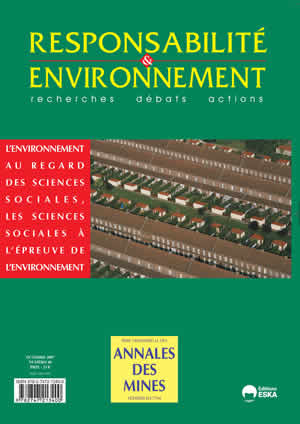
Responsabilité & Environnement n°48 October 2007

FOR OUR ENGLISH-SPEAKING READERS      

Environment seen by Social Sciences,
Social Sciences as challenged by Environment

 
Editorial

François Valérian

 
Introduction : From the environment to “sustainable development”, a view of relations between the social sciences and environmental issues

Stéphane Frioux

What the interdepartmental undersecretary of sustainable development expects from the social sciences
Christian Brodhag

What contribution can the social sciences make to sustainable development ? A decisive one if they prove capable of handling the essential questions raised by this new concept and, above all, of designing the tools necessary for a thoroughgoing change in society. The paradigms at issue shape the deepest layers of our society, whence the need to avoid being dragged down into vain debates. Sustainable development calls for a change of civilization since it transforms the relations between humanity and the biosphere, and does away with the boundaries between scientists and lay persons, between “soft” and “hard” sciences, between sure and uncertain knowledge. No surprise that conservativisms are mobilizing against it with the most powerful force in the world : intellectual inertia!


The environment, a subject of the social sciences

The environment, a subject of geography ?
Yvette Veyret

Far from the environment of naturalists who mainly study plant- and wildlife, the geographer’s environment is a web of relations and interactions between nature and society, or nature and culture. It is a subject that brings together social and “natural” data into a “hybrid” construct. It represents a major change from early 20th-century physical geography, which assigned a fundamental place to the “milieu”. Biophysical factors are not rejected but integrated from a different approach. For geographers, the environment is “given”, perceived, experienced and managed; it is a political issue with a natural place in the perspective of sustainable development.

 
A history of the environment ?

Geneviève Massard-Guilbaud

Although geographers and historians share the same definition of what “environment” means, these two disciplines are not advancing at the same pace. In France, history is lagging considerably behind and has somewhat left to others considerations about the dimension of time. This is unfortunate, not because historians hold a monopoly over the past but because they should, with their methods and approaches, stake out a position in this new area. The history of the environment might not cover a precise field of study, but it does bear a very specific viewpoint. Fortunately, there is hope : more and more young researchers are taking up the challenge. However there is still so much to do. We are at the start, at least here in France.

 
Economics of the environment or an ecological economics ?

Franck-Dominique Vivien

During the 1960s, the environment forced its way into economic theory. Economics responded with two epistemological positions : on the one hand, an “economics of the environment” and, on the other, an “ecological economics”. For the former, the environmental crisis is a period of transition, the environment having future prospects as an economic good (though a still imperfect one) like any other. In brief, the environment is fit into economic rationality and the ideal of the marketplace. For the second approach, the environmental crisis is a symptom that a threshold has been crossed and a new era of scarcity of our “natural capital” is now beginning. Accordingly, economics must take ecological rules and regulations into account; and economic rationality must make room for rationales that cannot be reduced to it and, in fact, have a much broader scope.

 
Talking about sustainable development

Nicole d’Almeida and Beatrice Jalenques-Vigouroux

The environment has become an endlessly expanding area of new information with : ever more legal obligations to inform, the development and delivery of more and more information, and the production and publication of exhaustive, unranked information accessible by everyone everywhere. The environment is an issue that allows for experimenting with new forms of dialog and debate with public hearings where new actors (watchful citizens) and a contemporary ideal of democracy are emerging. There is a major difficulty however : how to deal with complex issues while adhering to the principle of making messages intelligible and accessible, while introducing certainty in uncertain fields of knowledge, and while stimulating changes in behavior patterns without creating a blockage or disruption ?


From words to deeds

“Sustainable development”, a social success : What can it do for the social sciences ?

André Micoud

Sustainable development is inextricably a rhetorical figure of speech, a rational concept and a legal category that, altogether, involve designing and “instituting” another world. It calls for reconsidering how “natural” a whole series of figures, ideas and notions are even though they have become “ready-to-think” categories increasingly heterogeneous with regard to the now observable symbolic construction that institutes not only another world but also other human beings — whence the “remaking” of the social sciences that we are now witnessing. This also accounts for the surge in the anthropology of Western societies, which academics have started studying like ethnologists used to study precolonial primitive societies.

Sustainable development : A problem of translating words into deeds

Franck-Dominique Vivien

Twenty-five years after it was launched and despite apparent unanimity, sustainable development is still an “underexploited innovation” owing to the difficulty of grasping its essence and assigning it a precise content in terms of objectives or principles for enabling decision-making and action. For this reason, issues are dealt with by simply juxtaposing, or “pasting”, measures, actions and policies — with little originality and even less coherence.


For urban redevelopment : Managing an industrial legacy and inequality in Seine-Saint-Denis Department, 1850-2000
Anne-Cécile Lefort

As a symbol of the Paris suburbs and a concentrated example of the problems and handicaps of outlying urban areas, Seine-Saint-Denis Department bears the marks of an intense exploitation since the first half of the 19th century with no concern for the local economy, society or landscape. Now undergoing an economic recession, a reconstruction of its identity and a repatterning of its landscape, this department has to manage the legacy of industry and of past urban policies. Will the band-aid remedies now being applied heal this old socioenvironmental fracture ? The “suburban crisis” diagnosed in the media in 2005 suggests a negative answer.

The chemical industry and its neighbors, an ambivalent relationship : The greater Lyon urban area
Thierry Coanus, François Duchêne and Emmanuel Martinais

“Risk” is a hybrid notion, an ambiguous word; it is not well defined or accurately calculated once and for all. It is, in fact, relational. Understanding residents’ relations with next-door industries keeps us from adopting the much too narrow viewpoint of the professionals in charge of the technical and administrative management of industrial risks. The relations of “neighbors” to their industrial — but also physical, human and social — environment are not static. Instead of being defined once and for all by simple parameters, they are continuously adjusted to everyday micro-events. This gives rise to an ongoing interpretation and face-to-face relationships that require meaning. The neighbors of the chemical industry in Lyon, France, provide an example…

 
Sustainably managing natural resources

 
Sustainable managing woodlands in the late 17th century : The Grande Chartreuse
Émilie-Anne Pépy

Was the relation of the monastic orders to their natural environment an example of sustainable development, or is it an anachronism ? Without trying to delimit a contemporary topic by circumscribing a quite different area of history and thus risking that the scientific relevance of such an approach not be validated, we might, nonetheless, adopt sustainable development as a guide for thinking about the relations between societies in the past and their environment. In the French Alps, the Grande Chartreuse’s management of its forests evinced a concern for sustainable development. Woodlands were worked for the profit of the Carthusian monastery while opening access to this vital resource to peasants and conserving the forest and its resources. It would probably be more appropriate to talk about a sustainable management “like a good father’s”. This heritage has come down through the centuries : the same districts are now being worked as during the 16th century.

 
The start of fish-farming in 19th-century
France
Olivier Levasseur

Farming the sea and watercourses in response to an increasing scarcity of fish, “sowing fish in the sea like seeds in a field”… a clearing was made for the development of fish-farming during the second half of the 18th century; but the “aquatic revolution” actually occurred during the 19th century. In France, this revolution had to do with saltwater fish and oysters before freshwater fish. This originality of the French model would not have emerged without strong state interventions in terms of funding and legislation. This revolution created a new relation between people and their environment : the demand for an industry that satisfied the present while preserving the future. Sustainable development before our times ?

 
Angling and managing pisicultural resources :
Southwestern France from the late 1880s to the late 1930s
Jean-François Malange

At the very end of the 19th and the start of the 20th centuries, fishing enthusiasts formed several associations that expressed concern for the environment. These nonprofit organizations have mainly sought to preserve French watercourses and stock them with fish. In the quest to find the causes of problems, they have criticized industrial pollution, mapped and inventoried fish populations, interacted with scientific organizations, and undertook vast operations in fish-farming and hatcheries. Fishing enthusiasts have been mobilized throughout France. The history of fishing as a sport and past-time has become part of the history of the protection of our rivers and streams. Is this evidence of a growing awareness of environmental issues ?

Water resources, a source of wealth or a heritage in sustainable development policies ?

Florence Richard-Schott

Water, a source of wealth and an economic good to be worked in the interests of humanity, must come under ever more effective technical and technological control. “Appropriation”, “profitability” and “development” were the key words in water policies till the 1970s. Once a concern for the environment and questions about the impact of global warming arose, this exhaustible source of wealth was perceived as being menaced. It has become a natural resource that human activities have jeopardized for a long time but that a sense of responsibility for future generations leads us to preserve or even restore. By definitively placing the concepts of “wealth”, “heritage” and “water resources” at the center of “sustainable management” in major legal texts, we might make two visions compatible that have diverged for so long now.

 
The untenable sustainability of scientific practices ? When sustainable development questions the social sciences and society

Yann Calbérac