LES ANNALES DES MINES
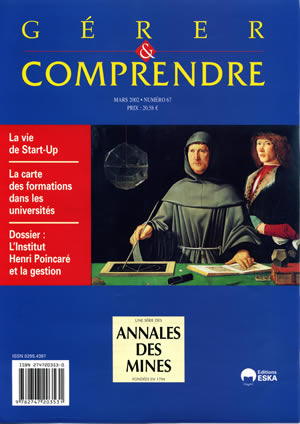
Gérer & Comprendre n°67
FOR OUR ENGLISH-SPEAKING
READERS
| OVERLOOKED
A startup’s life: Investing in innovative companies Olivier Marty The advent of information technology has led to the development of a
new economy with the emergence of avant-garde firms. Startups are defined
by the way they are financed and by the wager they represent on innovations.
A series of consequences ensue from these two fundamental aspects. For
one thing, the rationale of production in these companies is disturbed
by a "financial logic" based on the "capital of confidence" to be built
up with investors. This test differs significantly from the one that start-ups
face in the marketplace. For another thing, innovation and short-term constraints
force start-ups to maintain structures and job profiles of a very evolving
sort. This versatility leads to both a "culture of innovation" and the
vitality of relations based on a strong identification with leaders. However
these relations should not cover up the games of power played out around
this charismatic authority and for control over certain key technical qualifications.
If we add to this picture a rather homogeneous population with quite heterogeneous
motives, we are forced to admit that a startup forms a closed world with
its own rules of operation.
|
TRIAL BY FACT
How to accommodate innovation and reduce delays? A few lessons from the development of Laguna II Franck Aggeri and Blanche Segrestin Designing a new automobile is a strategic activity that brings together, adapts and changes different procedures in a special context in relation to strategic targets and as a function of distributed qualifications. This activity involves much more conflict than you would think when listening to managers talk. The Laguna II Project bears important lessons about how firms implement state-of-the-art managerial procedures and about how product development can be methodologically studied. Beyond handling the difficulties that cropped up, Renault had a surprising capacity to react to situations and ask questions. One of the most convincing pieces of evidence of this is the presence of researchers endowed with a broad capacity for inquiry. |
| Drawing up plans for higher education: In quest of a strategy for
establishments
Frédéric Kletz and Frédérique Pallez A controlled supply of education reflecting clear-cut objectives is
a major sign that a university has a strategy and a decision-making capacity,
regardless of what disciplines are taught. The gauge of what is conventionally
called "autonomy" is, therefore, the establishment’s policy for supplying
education. Despite detectable changes, diplomas and graduates still enjoy
a high degree of autonomy with only marginal regulation. A tension between
the "logic" of the disciplines and of the university is inherent in how
these establishment operate; and it may, as such, be fertile. Nevertheless,
questions can be raised about the conditions for a new equilibrium with
the right place for universities given stagnating enrollments and budgets
as well as growing competition — which will become international in the
near future — between establishments.
|
Restructuring firms: From economic rationality to human
beings
Maryse Dubouloy and Claude Fabre The mathematical rationality underlying several cases of restructuring in line with an essentially "financial logic" shows that the human implications are often overlooked, underestimated or even denied. In changes painful for people, it is essential to collectively take into account the emotional and psychological aspects of reorganization. In this context, gradually working out a reorganization strategy based on forward-looking procedures for managing human resources, adopting counseling and dialog programs for following up on change, and defining a clear-cut project are the very conditions for the human and economic success of a restructuring. |
| MOSAICS
Claude Riveline: The slumber of civilizations: On Daryush Shayegan’s Le regard mutilé. Daniel Fixari: Management’s subterranean forces: On Salvatore Maugeri’s (ed.) Délit de gestion. Dominique Jacquet: Back to the long run? On M. Baghai, S. Coley &
D. White’s The Alchemy of Growth.
A SHORT From the pure concept to practical applications and back: The tribulations of the Henri Poincaré Institute and of the Institute of Statistics (University of Paris) Francis Pavé |
TESTIFYING
Mathematics and society An interview with Georges Guilbaud conducted by Bernard Colasse and Francis Pavé In the years following WW II, applied mathematics found a haven for creation and development and the conditions for an exceptional diffusion inside the Henri Poincaré Institute; but all these advantages would be depleted by the 1960s. One of the leaders in this adventure was Georges Guilbaud. Inspired by Condorcet, this mathematician would, quite early in his career, take interest in how mathematics was used in various social sciences as well as in economics and management. He played a key role in developing operations research in France. The Henri Poincaré Institute at the origin of operations research An interview with Bernard Bru conducted by Bernard Colasse and Francis Pavé At the end of WW I, Émile Borel, an outstanding mathematician,
was appointed to the Chair of Probability and Mathematical Physics at the
University of Paris. At that time, statistics was hardly taught anywhere;
and the very idea of concretely applying mathematics kindled scorn among
"true" mathematicians. Nonetheless, Borel was persuaded that, in economics
and especially insurance, a demand existed for practical applications.
This intuition would, in 1928, beget the Henri Poincaré Institute,
which brought together mathematics in Paris and would, in turn, give birth
to the Institute of Statistics at the University of Paris. During the next
thirty years, the ISUP, led by remarkable men, would be behind the introduction,
in France, of education in statistics and of statistical applications in
industry, management and operations research.
|
|
|