LES ANNALES DES MINES
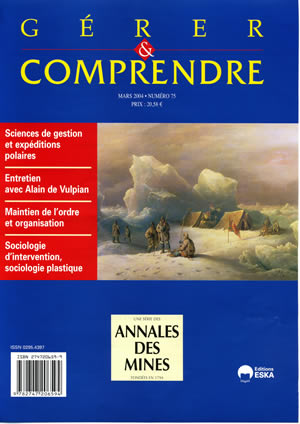
Gérer & Comprendre n°75
FOR OUR ENGLISH-SPEAKING
READERS
| TRIAL BY FACT
Toward a knowledge of action in the managerial sciences: The case of polar expeditions Pascal Lièvre Might
knowledge in the managerial sciences take the form of a model including
both the scientific knowledge that can be decisive for solving problems
and the practical, taken-for-granted know-how of persons in the field?
Such a model’s scientific value would be related to both the researcher’s
ability to explain the work of construction itself and the model’s capacity
for enabling those in the field to plan their actions. Recently used for
an expedition along Greenland’s western coast, the model for designing
a nutritionist strategy illustrates this sort of knowledge of action.
TESTIFYING Sociocultural changes and modernity An interview conducted with Alain de Vulpian by Bernard Colasse and Francis Pavé What to do to keep our societies from wasting the opportunities open to them and taking the wrong direction? This question has guided Alain de Vulpian during a career that has led him from the University of Political Sciences via the top management of COFREMCA in 1959 to the Club Jean Moulin today. Inspired by American sociopsychology and cultural anthropology, he and his colleagues, as both witnesses of and actors in the irruption of modernity in contemporary Western societies, have invented a genuine “ethnology of change”. |
WHILE READING
Managerial education: The firm in works of fiction, as seen through a few recent publications Hervé Laroche Organizations,
firms and management have been fundamental aspects of our world for a long
time now and will probably remain so. How do works of literature
depict them? Although novels provide insight into contemporary society,
writers of fiction have not yet explored these three topics. In this respect,
research in management is in advance !
MOSAICS Laurent Hua: Artificial intelligence and culture: On Denis Berthier’s Le Savoir et l’Ordinateur. Bernard
Buisson and Philippe Silberzahn: Resurrection handbook for firms: On
Jim Collins’ Good to great — De la performance à l’excellence: devenir
une entreprise leader.
|
| OVERLOOKED
The international standardization of bookkeeping practices: On the resistible rise of IASC/IASB Bernard Colasse The International Accounting
Standards Board and International Association for Statistical Computing
produce information for investors. These private international organizations
draw legitimacy for establishing bookkeeping standards from the English-speaking
world but have no power for seeing to it that the standards they approve
are put into practice. They have to constantly prove their legitimacy and
seek support from more powerful organizations, such as the International
Institute for Facilitation and Consensus (IFAC), the International Organization
of Securities Commissions (IOSCO) or the European Union. In matters of
accountancy, the EU is divided between a shareholders’ model as in English-speaking
lands and a partnership model as on the European mainland. The recent rejection
of standards 32 and 39 suggests that the supporters of the continental
model are impugning the reference to an English-speaking one.
|
OVERLOOKED…
The governance of air transportation and the rise of computer reservation systems Laurence SAGLIETTO Air
transportation exemplifies a successful, gradual opening of a network toward
competition. This opening has led to deep organizational changes and new
forms of regulation. The momentum in this sector can be assessed from various
angles. Lawyers, for example, tackle the question by debating the alternative
between deregulation and liberalization, thus leaving the supporters of
public management with the choice between competition and government interventions.
Economists focus on new forms of competition and networked marketplaces.
Approaches via strategic management to air transportation are more cautious,
and reorganization in this sector has hinged on airlines’ strategies.
|
| LIVE…
Keeping law and order as an organizational arrangement Arnaud Lacaze Created by an 18 November
1810 Napoleonic decree, the Imperial Corps of Mining Engineers has received
special attention because of the underground resources that it turns into
wealth and, too, because of the specific managerial methods necessary for
working mines. But for years now, it costs less to mine ore far from France,
in South Africa for instance. As a consequence, the Mining Corps is undergoing
a crisis. Miners regularly assemble in front of prefectures to petition
public authorities. Since an end might soon be put to mining, such impromptu
assemblies — paroxysms for prefectural authorities — are not without consequences
on law and order. What happens behind the scenes in this process for keeping
the social peace?
|
IN
QUEST OF THEORIES
A sociology of interventions, a plastic, mestizo sociology Gilles HERREROS An illustration is used to
suggest that a sociology focused on the social uses made of it within firms
and organizations would be better off if it avoided being restricted to
a single type of theoretical model. Interrelating disciplines, approaches,
notions, methods… this is the program of what might be called a sociology
of interventions, that would be both plastic and mestizo
|
|
|