LES ANNALES DES MINES
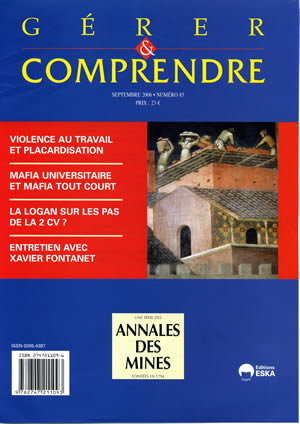
Gérer & Comprendre n°85 September 2006
FOR OUR
ENGLISH-SPEAKING
READERS
|
TESTIFYING See
far, act fast Xavier
Fontanet, president of Essilor International, interviewed by
Frédérique Pallez
and Francis Pavé How
to head a company formed out of a merger between a workers’ cooperative
and a
family business? How to manage a world group with a single product
whose
executive staff has national roots? This is the story of Essilor.
Negotiating
with stockholders, selecting the best, managing different “cultures”…
its
leaders do not hesitate to be present on all fronts. Since time is now
as
precious as gold, the key strategic weapons for Essilor’s top officials
are:
the agenda for executive meetings, permanent anticipation and speedy
reactions. OTHER
TIMES, OTHER PLACES Jean-Louis
Loubet Why
design a “cheap” car when automakers are dreaming of manufacturing
luxury
vehicles? What marketing studies led Citroën to bring out the
2 CH; and,
sixty years later, Renault, to bring out the Logan? Who was bold
enough,
during each period, to design a product that would change habits and
shake up
certitudes? The road was long from an ambient scepticism to the
excitement of
actually making a low-budget car. Engineers pulled out all stops to
find ways
to manufacture at a lower cost. However Citroën hardly believed
that the
2 CH would be a success; nor did Renault think that the west
European
market would show any interest in the Logan. Is success a divine
surprise?
Diego
Gambetta (a debated transcribed by Hervé Dumez) For
the mafia, regulating criminal marketplaces through violence is not a
satisfying economic choice; it is better to do this through ties of
dependence.
Does the university mafia apply the same principle? Since a person owes
even
more to the extent that he is incompetent, the temptation is strong for
a
“mandarin” to choose only the incompetent so as to maintain his own
control.
Fidelity comes to count more than merit. Woe betide whoever is nearing
retirement! They do not have enough time left to return favors, since
they are
on the way out and will soon be powerless. But what if someone is only
feigning
incompetence?
François
Mayaux and Laurent Ulrich Can
a diocese be run like a firm? No, since a bishop has a spiritual role
to fill.
Beyond his temporal duties, he has to be accountable… to God! But how
to revive
a “business” that has experienced a drop in the number of baptisms,
church
marriages, practising Catholics and priestly callings? How can a bishop
balance
the books when church offerings are drying up and when a quarter of the
diocese’s budget is devoted to expenditures related to real estate? The
Church
is going to have to make choices and professionalize operations. Is it
going to
sell its soul?
|
OVERLOOKED… François
Grima and Renaud Muller The
avowed intention to harm — a classical motive in detective
movies —
is also frequently part of the scenario in firms, which have no qualms
about
shelving employees. How to cope with this? Should the person remain and
organize his defense so as to put up a fight, or should he leave? A
shelf is
not a cocoon. Harassment takes several forms; violence is graduated.
The
workplace becomes a place of suffering… and a vantage point for
observers
interested in violent practices inside organizations. What if all these
methods
were a flexible modality of employment that is less visible than the
contingent
workforce? Harold
Levrel How
to design indicators for a hard-to-define scientific phenomenon that
very few
scientists have observed? Doing this in the case of biodiversity is a
wager.
Nonetheless, CRBPO (Centre de Recherche sur la Biodiversité des
Populations
d’Oiseaux) has designed a system of indicators (Stoc, Suivi Temporel
des
Oiseaux Communs) for following up on the dynamics of bird populations.
Developing this system meant, first of all, reckoning with the costs of
transactions between local organizations of ornithologists, volunteer
or
professional, and proposing a common language for reducing these costs.
It then
entailed an inquiry into information needs in order to develop a
sufficiently
flexible tool that can evolve. Finally, it called for trusting users
and taking
the risk of entering into competition with other systems.
Did
you say “human capital”? Fabienne
Autier Wage-earners
are not yet familiar with the phrase “human capital”. In the near
future
however, head offices might need to reconsider everything having to do
with the
firm’s “government” in relation to this sort of capital. Mostly
immaterial and
inseparable from its holder, human capital is going to shake up both
human
resource policies and control. Now as vital as financial capital, it
should be
the focus of investment programs and be reckoned with in terms of
overhead and
amortization. We might even imagine recruitment policies and a
“knowledge
economics” based solely on this criterion. Firms could be increasingly
distinguished between the ones that try to minimize human capital and
those
that accept to pay a fair price for it. MOSAICS Jean-Baptiste SUQUET: Ideal
workers in an ideal organization: On Marie-Anne Dujarier’s L'idéal
au
travail (Paris: Presses Universitaires de France, 2006). Jean-Marc WELLER: Technical
democracy: On Nicolas Chevassus-au-Louis’s Les briseurs de
machines: De Ned
Ludd à José Bové (Paris: Seuil, 2006). Arnaud
TONNELE: Changing the way of looking at unemployment: On Pierre
Cahuc and
André Zylberberg’s Le chômage, fatalité ou
nécessité? (
|
|
|