LES ANNALES DES MINES

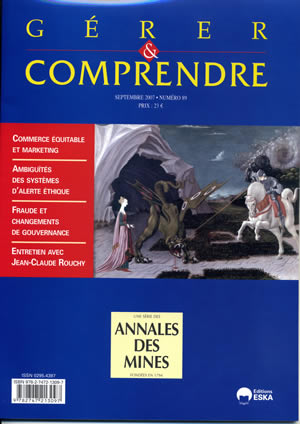
Gérer & Comprendre n°89 September 2007

FOR OUR ENGLISH-SPEAKING READERS 


TESTIFYING

The French pioneers of psychosociological interventions in firms

Jean-Claude Rouchy interviewed by Bernard Colasse and Francis Pavé

An innovative approach to managerial practices in companies can precede a deep cultural revolution in society. Such was the case for “psychological interventions in firms”, an approach pioneered by Jean-Claude Rouchy in France during the 1950s. He tells us how a very small group of friends with rudimentary means upset preconceived ideas about the individual’s place in organizations. This new discipline and practice had to be created, the idea being to use group dynamics as a method of change. Anglo-Saxon influences, the role of psychosociology, involvement in CEGOS, the foundation of an association for psychosociological research and interventions (ARIP), the creation of his own practice, the launching of Connexions… J.C. Rouchy (chief editor of this journal and of Revue de psychothérapie psychanalytique de groupe) wants to devote energy to both thought and action (His brother died in a concentration camp during WW II…). Having found his own way, he has a predilection for intellectual debates even at the risk of controversy and ruptures. His experience in the field included Italy during the era of the Agnelli Foundation. In France, he has witnessed the obstructions to changing the national system of education, and observed the success of the Ministry of Health’s Toxico-Sida Plan for fighting against AIDS. Is Jean-Claude Rouchy the last in the spirit of ARIP?


TRIAL BY FACT

Does marketing make activists in the fair-trade movement sell their souls?

Ronan Le Velly

The success of the fair trade movement should be measured by its rising sales figures, since they would be evidence that more and more Third World producers are being better paid. Why do traditional marketing tools bother — even disgust — the volunteers involved in fair trade who are supposed to use them? As the findings of field work conducted in two major French non-profit organization show, everything hinges on how these marketing tools are adopted by users. The meanings associated with these methods affect these persons’ identities. Once globalization and business ethics are at stake, matters become complicated when activists do not want “all this to be reduced to interesting ideas for interesting symposiums”.


The ambiguities of whistle-blowing

Marie-Hélène Larue

Obsessed by the memory of denunciations under German occupation during WW II, the French are reluctant to adopt whistle-blowing, a set of practices imported from America. To set off an “ethics alarm”, wage-earners are asked to denounce, more or less anonymously, actions that do not seem “ethical” to them in the firm where they work. In phase with a “mass media society”, this system also enables big firms to preserve an untarnished image by covering affairs up before they explode. Does this system, mid-way between good intentions and managerial manipulations, reveal a new “corporate culture”? Research involving nine ethicists lets us pensive… Might a lack of legitimacy ultimately account for the slight success of whistle-blowing in France or for its misuse? A truly ethical approach cannot be satisfied with the postulate of a model wage-earner who advocates entrepreneurial ethics.


OTHER TIMES, OTHER PLACES

For the country, science… and fraud! The Deprat affair caught up in changes of governance

Jean Behue Guetteville

Fraud, its form and treatment, is evidence of a certain type of governance. This deviant behavior reveals a new lineup of forces. From this perspective, a thrilling tale is told about 20th-century science, politics and society. The Deprat affair takes us back to Indochina in the years after 1910, where academics and colonial administrators, specifically two careerists, were waging a ferocious battle. Deprat — right but ahead of his times about the theory of continental drift — cast doubt on prevailing beliefs and on the methods used. At issue was the relativity of judgements, even scientific ones. Truth and fraud invite us to observe changes…


OVERLOOKED…

A lost job, a career opportunity?

François Grima

Tactics, objectives, adjustments and, above all, the costs of adaptation… all this provides a different approach to the problem of “returning to employment”. Let go of the prevailing image of a passive, jobless person under stress! Let’s take a critical look at recent developments in studies of how persons “rebound”. There are countless patterns of job changes, and we need the right instruments for detecting them. The white-collar who is looking for work is tailed: his past, tracked down; his family life, revealed; and his list of contacts, examined. Everything comes under analysis. The results (in particular about the person’s social network) might be disappointing. Individuals obviously have the ability to find a new balance but only if they can bear certain costs.


MOSAICS

Michel Villette: Working class or millionaires? Traders fight to obtain a bonus! On Olivier Godechot’s Working rich: Salaires, bonus et appropriation du profit dans l’industrie financière (Paris: La Découverte, 2007).

 
Olivier Lenay: Artists, managers at heart?
On Catherine Strasser’s Du travail de l’art. Observation des oeuvres et analyse du processus qui les conduit (Paris: Éditions du Regard, 2006).

 
Annabelle Gawer: Innovative design, a condition for the firm’s survival in the 21st century: On Pascal Le Masson, Benoît Weil and Armand Hatchuel’s Les processus d’innovation : conception innovante et croissance des entreprises (Paris: Éditions Lavoisier, 2006).


IN QUEST OF THEORIES

Is the gift a managerial concept?

Jean-Paul Dumond

The organization of the world of work seems remote from a gift economy. Management seeks to improve efficiency whereas the idea of a gift evokes religiosity. However both of these are underpinnings of society. How to recognize gifts out of the many forms of transactions that take place? To what extent can they be an analytical tool for managing organizations? Following an existential approach to the making of gifts, fieldwork in a hospital-city network is used to show that gifts easily enter into the dynamics of an organization. But can gifts actually be managed? The gift as a limit to management’s interference in human activities…


 Retour sommaire