LES ANNALES DES MINES

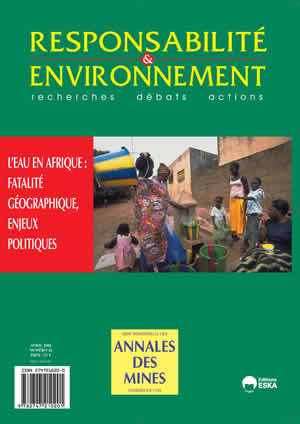
Responsabilité & Environnement n°42 April 2006

FOR OUR ENGLISH-SPEAKING READERS     


Water in Africa:
Geographical fatality and political issues

Water resources

The challenge of water in Africa

Jean-Louis Oliver

The question of water in Africa provides an opportunity to the international community for building a common future, between solidarity and diversity, by imagining a new sort of partnership, since older (contractual and conditional) approaches have mostly failed. Underlaid by mutual respect, this North-South and South-South “co-development” should be based on a realistic analysis of successful practices in the field. This is the necessary condition for a fairer world where Africa would have its full place.

 
Water management: Between Western and African models

 The dangers of irrigation

Jean-Noël Salomon

Given the irregularity of rainfall in Africa, irrigation is a necessity but with risks of jeopardizing alluvial deposits along the coast, exhausting fossil underground water, salinizing irrigated land and, not to be forgotten, having detrimental effects on human health. Furthermore, big irrigation projects displace populations, change ancestral agricultural practices and stoke major conflicts between countries.

 
An African success story, SODECI in the Ivory Coast

Marcel Zadi Kessy

After initial hardships when set up as a small business in 1960, the Société de Distribution d’Eau de Côte-d’Ivoire (SODECI) has now become a public water utility that counts in Africa despite underdevelopment and cultural factors. Its executives have understood the need to make African traditions compatible with the universal laws of modern management. This success story has turned restrictions into advantages owing to an African-style management.

 
Privatizing the water supply in
Mali (2000-2005)

Francis Leborgne

How to manage water in one of the world’s poorest countries? Lack of training, corruption, the presence of several ethnic groups, all these factors complicate water management in Mali. Since 2000, Eau du Mali, a private company, has renovated the system by mobilizing teams and working out relations built on mutual confidence. We might try imagining how to reproduce this model elsewhere.

 
An assessment of the privatization of the water supply in Africa

Sophie Trémolet

The dogma prevalent during the 1990s postulated that privatizing the water supply was “the” solution to African problems. Financiers adhered to it, making it the sine qua non condition for their backing. Initial euphoria is over. What assessment has been drawn ten years later? A few reasons for successes or failures and a suggestion: the time has come for a second wave of reforms that take into account actual situations in the field and make room for a renovated public sector as well as local private companies.

 
Water for everyone? Questions of fairness

The water supply in poor communities: The experience of Suez-Environnement

Alain Mathys

Improved access to water in Africa is not just a question of money. A strong political determination is necessary to set the priority of making drinking water available to the poor and to undertake realistic reforms for this purpose. Technical means are also necessary, as well as partnerships with public or private operators so as to obtain better results. An ongoing dialogue must take place with people living in poor neighborhoods, who must become involved. Suez-Environnement’s experiences in Morocco and South Africa provide an illustration…


Women and water in Africa

Eirah Gorre-Dale

Nowhere else in the world is the havoc wrought by the shortage of clean water as alarming as in Africa; nor is the sexual division of labor in the management of natural resources as flagrant. The international community has become aware of this, and progress is being made. But the UN’s Millennium Development Goal of halving by 2015 the percentage of the population without access to drinking water cannot be reached as long as programs for supplying and purifying water do not take into account disparities between men and women. From Mozambique through Zambia, Uganda and South Africa to Burkina Faso, noticeable examples have proven how crucial the role of women is. These examples need to be generalized to the whole continent.


Will advanced technology play a significant role in dealing with the urbanization of African countries?

Alain L. Dangeard

How — given limited manpower, technology and funds — to cope with unhampered urbanization and its environmental impact? How to break out of the vicious poverty cycle? Africa hardly has a choice. To attract a minimum of investment, its strategies will have to focus on environmental risks. This might be its major contribution during the breakneck race under way toward globalization.

 
Finances and aid

Water in Africa: Financing investments

Inès Frailé

Developing the water supply in Africa is one of the UN’s Millennium Development Goals. It is also a prerequisite for the continent’s economic and social development, which calls for doubling annual investments in this sector. How to raise the capital necessary for such a far-reaching goal, given that budgets are limited and international aid will be able to fund but a small part of the needed investments? An ambitious program of reforms should be launched to attract private funds, boost financing from local capital markets, increase rates for users, improve efficiency and reorient subsidies toward the poor.

 
Water, a challenge for French local authorities involved in decentralized aid programs

Charles Josselin

Water is not fairly spread over the planet. This is both a major preoccupation for big international organizations and a concrete issue in the aid programs that French local authorities have worked out with villages and towns in Africa. From the allotment of a budget to actual realizations… a series of actions by local authorities belonging to Cités Unies France.

 
Sharing the planet’s vital resources: Decentralized cooperation with Africa

Questions for André Santini

“In 19 years, since our aid program was set up, more than 1.800.000 people have directly benefitted from improved access to water thanks to the hydraulic projects that have been carried out.”

 
Miscellany

The Courrières catastrophe as seen by the Conseil Général des Mines, and its immediate consequences on safety in the mines

Philippe Saint Raymond

A hundred years ago, on 10 March 1906, a blast killed 1099 coalminers in Courrières (northern France). Heated debates took place about the organization of rescue operations and the equipment of French miners in comparison with other countries. The Conseil Général des Mines launched a study that, four years later, led to France’s first set of coalmining regulations.