LES ANNALES DES MINES
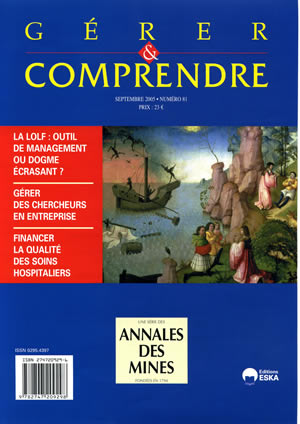
Gérer & Comprendre n°81
FOR OUR
ENGLISH-SPEAKING
READERS
| OVERLOOKED… LOLF, a
mere management tool or a grueling
dogma ? Arnaud LACAZE How to explain why the French Police and Gendarmerie are so attached to using an array of statistical indicators in order to uphold the rule of law and defend the general interest? How to assess the performance of security services given that they achieve their purpose whenever certain actions are thwarted and nothing happens? Following a criticism of how the Organic Budgetary Act (Loi Organique relative aux Lois de Finances, LOLF) has been adapted to managing police forces, questions are raised about the relevance of a managerial approach that sets objectives for public services and about the legitimacy of a tool that has gradually been imposed as being self-evident and a matter of consensus. Might this tool not be a doctrine or a powerful dogma that should arouse the critical spirit of managers in the public administration ? TRIAL BY FACT Managing
researchers in firms: Careers,
project assignments and the management of skills and qualifications François FORT and Daniel
FIXARI How are the careers
of researchers managed? How does career mobility work for them,
especially for
researchers in the public sector in
The
shop’s window or the back room! The role of
Territorial Operation Contracts in Guadeloupe Eduardo CHIA
and Michel DULCIRE Applying the
Farming Orientation Act (Loi d'Orientation Agricole, LOA) in Marie Andrée CARON Accountancy,
an
ancestral knowledge, is acquiring more powers granted by firms. It is
trying to
be reassuring so as to enable managers to act from a distance in a
redefined
space-time continuum, even as “risk society” — characterized by a
time of
turmoil, opportunities and risks — is turning the profession into
a
threat. To clearly discern the stakes in the exercise of the
bookkeeping
profession, it is of utmost importance to look beyond the purely
technical
aspects of accountancy and try to understand the meaning that
accountants give
to their actions during interactions with personnel who are not
bookkeepers.
Having conducted more than thirty interviews with professional
accountants in
|
OTHER TIMES,
OTHER PLACES Jean-Pierre DUPUIS Nowadays,
even as most anthropologists are seeing
cultures
as being dynamic and open in interaction with each other, intercultural
management is having trouble incorporating this knowledge and opening
toward
interactionist approaches to culture. How, for instance, to explain the
refusal
of certain persons in
François
VALÉRIAN, Success,
between merit and negotiation ? On
Michel Villette and Catherine Vuillermot’s Portrait de l’homme
d’affaires en
prédateur. Blanche
SEGRESTIN, A
different governance ? On
M. Aglietta and A. Rébérioux’s
Dérives du capitalisme financier. Sébastien
GAND, Managing one’s self in a firm, or
the dangers of “psychologizing” management: On Valérie Brunel’s Les
managers
de l’âme: Le développement personnel en entreprise,
nouvelle pratique du
pouvoir ?
DEBATES H. DUMEZ The CONDOR seminar
devoted its
Dr. Etienne MINVIELLE The French medical
insurance system seeks to guarantee a homogeneous level of quality in
all
health establishments instead of turning quality into a factor of
discrimination as in the competitive North American system. But this
intention
has a noticeable limit: what cost load is society willing to bear to
pay for
quality? An analysis of the situations wherein regulators are led to
balance
quality with accessibility and cost shows that, with the introduction
of
financing for quality care, they will be able to make better informed
choices
but, too, will have to cope with increasing complexity and greater
social
pressure for ever more quality. This trend might be inevitable.
Regulating
quality means formulating a public health imperative, in particular
about
reducing risks. Becoming more accountable out of a concern for
improving
quality means responding to the strong demands voiced by citizens and
by
professionals.
Francis PAVÉ
|
|
|