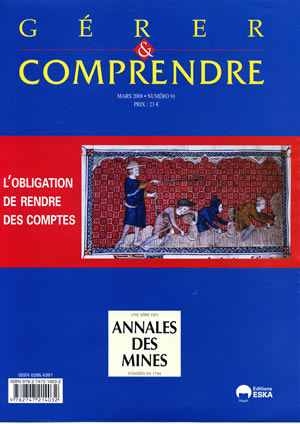
LES ANNALES DES MINES
Gérer & Comprendre
n°91 March 2008
FOR OUR ENGLISH-SPEAKING
READERS
|
The obligation of accountability
PRESAJE
Institute has asked a work group from the AEGIS research program,
coordinated
by Hervé Dumez, to reflect on the concept of accountability.
This familiar
concept, whereby a person who acts on behalf of an organization must
account
for his actions, raises more problems than expected. Coming from this
work
group, the articles on this theme inquire into how accountability is
put into
practice in firms, hospitals and research centers. This thematic issue
reaches
back to the origins of this concept in the British context.
The
English notion of accountability is hard to render in French, because
it is
hard to understand outside a long tradition of jurisprudence. Neither
the same
as responsibility or liability, nor as the possibility to incriminate
someone
for his actions, this notion’s relation with these other concepts
varies from
one field to another. To blame someone — whether a trustee, spy,
employee,
judge or minister — for his actions, it is sometimes necessary to
prove
that the person had an obligation to account for them. Recent
developments in
corporate law, given the rather broad range of information that
companies
quoted on the stock exchange must provide, could unsettle the finely
wrought
balance between accountability and responsibility, which has slowly
evolved
since the English Middle Ages. This article is published in its
original
language in order to allow readers to discover all the nuances
necessary for a
full understanding.
What
place do theories of corporate management assign to accountability?
What
perception do parties inside a firm have of it? The responses to these
two
questions gleaned during a survey of “middle managers” come as a
surprise. The
theories about how organizations operate have devoted little thought to
this
concept, and these managers’ perceptions of it are not what we expect.
Accountability is perceived as a form of control rather than as a
managerial
tool; it has connotations so negative that other words are used:
reporting,
discussing, reviewing, etc. Nonetheless, managers spend their time
accounting
for their actions but in their own way and at their own pace. Bertrand
Fauré What are the implications of accountability in the building industry, which is continuously adjusting to the business cycle? The example reported herein has to do with budgetary controls at a construction site that was in the red. It sheds light on the interactions between the chief engineer, project director and comptroller as they try to present monthly budgetary reports that take into account the exigencies of both the site and annual budget. The complex dynamics of accountability provide us with a glimpse of an extremely codified system: the budget is built to be validated even if this means “troweling” over rough spots so as to appear responsible. This informal norm of aesthetics in bookkeeping might become a decisive factor for presenting managerial competence. Ranking
hospitals: A new method of
accountability How
to ask those who wield knowledge in a field where trust is essential to
account
for their actions? This is the crux of the issue in medicine. Not that
medical
professionals refuse the idea of accountability — on the contrary,
the
world of medicine has switched from opaque procedures of
“self-evaluation” to
an overexposure due to the rankings to which the media have given high
visibility. Besides, accountability concerns not just expenditures but
also the
quality of care. Given the proliferation of rankings of hospitals in
|
Researchers
and the obligation to account
OVERLOOKED… Orchestrating
assets to remain competitive:
Raytheon’s strategic trajectory What
strategy can a firm adopt to remain competitive in a fast-changing
environment?
Are ideas and practices modified as fast as changes take place? The
case of
Raytheon in the American defense industry shows how a company tries to
face the
future in a permanently innovative way, how it constructs its “capacity
to be
dynamic”. During each major change in the environment (the end of the
Cold War,
the current technological revolution), Raytheon has tried to
orchestrate its
assets as best possible to anticipate the future: selling and buying
assets
while reorganizing — all this under scrutiny by the financial
markets,
which do not fail to pronounce judgment on the nomination of top
executives. We
imagine the uncertainty surrounding the success of this orchestration! IN QUEST OF
THEORIES
The
race to bring out new products is a central factor in a capitalistic
economic
system. Innovations must always be forthcoming so that people go on
consuming.
This accounts for the multiplication of R&D projects, a key sector
in
organizations. But how to capitalize on the knowledge coming from such
projects
so that all this energy and all these innovations serve for future
projects
without lost time and with maximum efficiency? Evidence from a case
study in a
multinational high-tech firm shows how much the forms and contexts of
this
capitalization of knowledge are decisive. The coexistence of distinct
models in
a firm reveals the importance of a “leader-group-situation triptych”. A
decisive factor: how managers exercise leadership… MOSAICS
Blanche
Segrestin: Firms do not exist! Invent them! On Daniel
Bachet’s Les fondements de
l’entreprise — Construire une alternance à la domination
financière (Éditions de
l’Atelier, 2007).
|
| |
|