LES ANNALES DES MINES

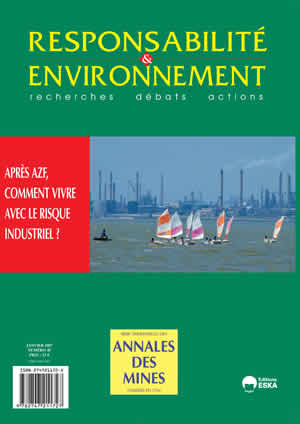
Responsabilité & Environnement n°45 January 2007

FOR OUR ENGLISH-SPEAKING READERS  


Introduction : Five years later                                       

 Laurent Michel

Five years after the AZF chemical plant in Toulouse, France, exploded, what has the act of 30 July 2003 on the prevention of technological and natural risks changed ?

 
Industrial risks

AZF, the lessons learned from an industrial catastrophe

Nicolas Dechy, Didier Gaston and Olivier Salvi

The AZF catastrophe has left lasting marks in memories. It was a traumatic experience for the inhabitants of Toulouse. Although the inquiry into the causes has not yet cleared up all questions, this event along with the law adopted thereafter has opened the way toward the sustainable development of industry and urban areas. It has enabled France to be the first in Europe to strike out in a direction now supported by the European Parliament, which, drawing conclusions from Enschede and Toulouse, has acknowledged the Seveso directive’s limitations. Given that risks cannot be reduced to zero, how to move toward a rationale of “fending off risks” ? Reports from the National Institute of Industrial Environment and Risks (INERIS) serve as the basis for this description and assessment of this catastrophe’s consequences.

 
The performance of indemnities from the victim’s viewpoint: The case of AZF

Anni Borzeix and Laure Amar

A catastrophe often has an impact that lasts long beyond its immediate effects. Five years later, what consequences has the AZF explosion had for persons living near the plant ? How have arrangements worked that were set up a month after the accident for taking the victims “in charge” and indemnifying them swiftly, flexibly and fairly ? How did the victims experience them ? Why did the information they received often turn out to be insufficient or inadequate ? Feedback from these arrangements…

 
Industry and urbanization: A plan for coping with unacceptable situations — the example of Mazingarbe

Lionel Joubaud

Following the AZF accident, the act of 30 July 2003 on the prevention of technological and natural risks intended to make industry and urbanization compatible and to cope with the most unacceptable situations inherited from the past. A noteworthy part of this act is the plan for preventing natural and technological risks with its three aspects for developing industry in an urban environment: reducing risks at the source, controlling urbanization and undertaking joint efforts. What conclusions to draw about such a recent measure ? What advances have taken place ? What questions (in particular, about funding) have been left hanging ? Initial responses from the pioneering experiment conducted at Mazingarbe in northern France.

 
Looking back on industry’s experiences

Denis Dumont

Since the start of industry, engineers have worked on the technical aspect of accidents so as to reduce their frequency and effects. To draw lessons from this history, a dialogue must be organized in factories; and lines of communication, opened with society. Twenty years ago, engineers laid emphasis on the sensitive question of managing human organizations. Nowadays, they need to be aware of communication problems. Reducing accidents depends on society as a whole learn abouting the technological risks to which it is exposed and actively taking part in managing them.

 
Current issues about controlling the safety of nuclear reactors

Pierre Charpentier and Olivier Gupta

Three Mile Island in 1979 and Chernobyl in 1985: accidents, questions and advances in risk management have marked the history of civilian uses of the atom. Probability studies on the safety of reactors, control over organizational and human factors, and EU “harmonization”: three examples of implementing a policy for continually improving safety conditions in reactors under the control of the French Nuclear Safety Authority (ASN, Autorité de Sureté Nucleaire)… and three illustrations of the benefits of international cooperation and of collaboration with other industries. Here too, we can advance only by paying close attention to what is being done “elsewhere”.


An agenda for strategic research on industrial safety

Olivier Salvi, Eric Charikane, Didier Gaston and Georges Katalagarianakis

Our societies are calling for industry to improve its safety record. In turn, industry has demanded support for research on safety, which, at the junction between technical expertise and business, cannot be separated from a strategic policy of industrial innovation in Europe. The EU’s technological platform on industrial safety and its national counterparts has satisfied this demand. At stake: reducing the number and impact of accidents, and keeping abreast of technological innovations. Initial results are encouraging. But for safety to be seen as a driving force in innovation and a factor of productivity, a major cultural change still has to take place. The road is long, but do we have any choice other than sustainable industrial development ?

 
Policy responses

 
The 2003 act on risk prevention: What is going to change from the plant operator’s viewpoint ?

Jean-Marc Jaubert

What provisions does the act of 30 July 2003 contain ? What is going to change for those who operate industrial plants ? The keystone in the whole process: dangers will be studied; and risks, fully analyzed in all their complexity. The plans for preventing technological risks (PPRT) are the key feature in the law. As a means for managing urbanization, they are to reinforce over time the coexistence between industry and the residential environment. The act also provides for setting up local committees of information and cooperation (CLIC). Studies of the AZF accident in Toulouse have infused the law with three major themes: risk analysis, the consequences for urbanization, and the degree of acceptability by society. The 2003 act offers a response… but halfway measures must be avoided.

 
Joint efforts: A new dimension for local risk management

Myriam Merad

The accident in Toulouse on 21 September 2001 exposed the shortcomings of regulations on industrial risks, but also provided the occasion for modernizing safety measures thanks to the act of 30 July 2003. Joint efforts in France often arise out of the laws, decrees and circulars that condition the phases, modalities and forms of coordination. By setting up local committees of information and cooperation (CLIC), the state has recognized and redefined the place for joint efforts and coordination between the parties involved in preventing industrial risks. Room has been made for local parties, communes, associations and citizens; and funding, allocated for their actions. However this new setup must not overlook the history of cooperation in local areas where industry has left deep imprints.


Did you say “citizen participation and information” ?

Lothaire Zilliox

With its provisions for local committees of information and cooperation (CLIC), the act of 30 July 2003, in its response to the AZF accident, intended to reinforce information and cooperation in industrial areas where at least one plant is rated as high (“Seveso”) risk. The intent is to collectively learn from technological risks and invent new forms of ongoing dialogue between the public, manufacturers, authorities, scientists and journalists. Will this open, pluralistic, permanent dialogue, as put into practice by the Secretariat for Preventing Industrial Pollution (SPPPI), be conducted in symbiosis with the CLICs recently set up at the local level ? Five years later, the memory of the accident in Toulouse leaves no other choice.


Before and after the AZF explosion:
France Nature Environment’s point of view

Christine Gilloire

Are catastrophes needed to make the law change ? Following the AZF explosion in 2001, modifications were introduced in the act of 1976 on classifying installations to protect the environment; and a major reform was made with the act of 30 July 2003 on the prevention of technological and natural risks. This law lays down a new method for assessing industrial risks and improves safety conditions for those who live near or work in dangerous factories. However short-term economic interests still prevail in matters related to health and the environment. To strike a balance between business and safety, the principle of prevention has to be enforced; and polluters, made to pay. For this reason, France Nature Environment is calling for a rapid transposition into French law of the EU directive on environmental responsibility.


Notification: The guarantee of a “statute of limitations” for plant operators

Me Hercé

What are the consequences of the formal notification served to the operators of plants classified as dangerous ? What rights and obligations does the operator have ? What are the administration’s ? A long, winding law suit has provided an administrative law judge with the opportunity to grant, by successive interventions, these notices a special status. Although several points have been clarified, ambiguities still persist, in particular with regard to time limits. According to courts of administrative law, a notification extends a substantial guarantee to plant operators who cannot, therefore, be deprived of its benefits.

 
Controlling industrial risks: Remaining reasonable

Michel Turpin

The act on risks adopted in 2003 in reaction to the explosion in Toulouse might advance the cause of safety in industry. Regardless of the efforts made however, risks are and will remain an unavoidable consequence of human activities. Beyond complying with regulations or adopting the right practices or rules, controlling risks means running counter to a production process that is always stronger than the concern for safety. Adaptations must be made to increasingly complicated systems and to firms in a permanent state of flux. We must fight against inertia, routines, complacency and the taboos created by our culture. How to do this ? By relentlessly paying attention to education and training, by involving all the personnel and by accepting a comparison with peers.

 
Miscellany

Climatic changes: A look at a complex of menaces

Paul-Henri Bourrelier

In 1895, Arrhenius, a Swedish scientist, estimated how much using coal as a fuel would eventually raise the atmosphere’s temperature. A few decades later, Gibon, an English economist, erroneously predicted that British coal reserves would run out within a century — the right horizon but the wrong figures. Eighteen years ago, Bourrelier’s Le mobile et la planète ou l’enjeu des ressources naturelles presented the problem of CO2 and CH4 emissions as being symmetrical to that of the depletion of oil reserves. At stake was the right management for the planet’s limited resources and the geopolitics of the profits generated by them. By taking this as our bearings, we can examine the distance covered since then and investigate the four points that stand out in this debate.

 
Against the greenhouse effect: Let vehicle-owners pay for “bioheat” instead!

Henri Prévot

Biofuels or “bioheat” ? To reduce greenhouse gas emissions, it is better to concentrate on bioenergy and to let the economy find the best method. It would be more effective to devote the efforts required of those who use motor vehicles to tapping the biomass as a source not of biodiesel fuel but of heat instead.

 
Climatic change: EU proposals for the years after 2012

Patrick Nollet

To continue playing a leading role in developing an effective policy for fighting against climatic change, it is urgent for the EU to improve the efficiency, in both economic and environmental terms, of its system of tradeable emission permits. A few proposals are made for this purpose. Minor modifications of the system do not suffice. A global, long-term, gradual EU policy on greenhouse gases must be worked out that is based on a “globality of efforts” and long-term objectives.

 
The wastes market: Growth, concentration and restructuring

Gérard Bertolini

An unstoppable process of concentration is threatening competition in the wastes market. This phenomenon, though not new, has sped up and is changing scale. Mergers are giving birth to bigger multinational groups that are being restructured in various shapes. American groups are specialized whereas the leading groups in Europe (especially the French ones) are diversified — most of their business coming from energy and water instead of wastes. What will result from all this ? How will high finance and investment funds, given their increasing role, affect stability in this sector ?

 
Mining and financial backing: A decision by the Conseil d’État

Yann Aguila

A July 2006 decision by the Conseil d’État, the top judiciary in French administrative law, has confirmed the conditions under which the public administration should exercise tight oversight over the financial backing of demands for mining licences. In this case, a lower court turned down the request for a licence to mine gold and related minerals on the grounds that the company did not have sound financial backing. The firm appealed to the Conseil d’État, but the latter upheld the lower court’s ruling. We thank Yann Aquila, whose arguments served as the basis for this decision, for allowing Annales des Mines to publish his conclusions.

 
Natural catastrophes: The virtues and limits of a local approach to a consensus: The example of the Séchilienne landslide

Minutes of the meeting of the Club des Annales des Mines held at the École des Mines in Paris, 13 June 2006

This meeting was headed by Paul-Henri Bourrelier, a member of the French Association for Preventing Natural Catastrophes and chief mining engineer. Participants included: Gilles Strappazon (mayor of Saint-Barthélemy-de-Séchilienne), Philippe Huet (chief engineer in the Service of Water and Forests and a member of the General Inspection of the Environment), Yvette Veyret (professor of geography), Thierry Trouvé (delegate of Major Risks in the Ministry of Ecology and Sustainable Development) and Philippe Dumas (a member of the General Inspection of Finances).